This is the second in a series of essays on the Edwardian and Pre-War Era, centered mostly on events from 1900-1914. Parts of this particular composition read like a Fairy Tale; others like a nightmare. All of the key elements are historically true.
—
Preview
It is 1904. On a dark night, in the middle of a cornfield somewhere in America’s wide girth of a midsection, an adolescent lad lies anxiously awake. Occasionally flickering lights are visible from his berth in a wood frame passenger car of the Missouri Pacific. As the car rattles along, he is wondering about his future — he cannot possibly know what it is like where he is going. And he can’t help thinking about his difficult, troubled and hardscrabble past; hopefully it is very far behind him.
The trip is mind-bogglingly long for most people of this era and his background — over 1,200 miles — with multiple transfers in large strange cities. Yet, for him, it is much more than a boy’s epic journey, to be told and re-told later in life. It is a for him a true rite of passage: a transcendence not only from boy to man, but also from one culture to another; from obscurity, to brilliance.
——————————————-
A brief eight years later, he would be recognized as the world’s greatest athlete. One hundred years later, he would be recognized as the greatest athlete of the 20th century.
How all this came to be — how he achieved so much, yet came to receive so little acclaim or reward during his life, and how he died a relatively obscure pauper — is a story that needs to be told and re-told.
——————————————-
Youngest Years
In May, 1888, twin boys were born to Charlotte Vieux in a tiny wood-plank dirt-floor house in Indian Territory. Charlotte was of mixed French and American Indian (mostly Potawatami) decent. She and her husband, Hiram Thorpe, who was also one-half American Indian (Sauk-Fox) and half Irish, were devout Catholics. They named the boys, their fifth and sixth children, Jacobus and Charles; although they would commonly go by “Jim” and “Charlie.” Charlotte would bear Hiram 11 children in all, before dying from childbirth.
Jim Thorpe had a difficult youth. Most of his siblings died before he left in 1904, including his best friend, his twin Charlie, at age 9. His father, Hiram, had to be a tough man to run a 1,200 acre spread along the Canadian River, growing wheat and raising cattle. He was a hard man: he ran his household with an iron fist, pushed himself hard, pushed his sons hard, drank hard, fought hard and partied hard. He was a well-known moonshine runner and barefisted fighter.
Thorpe was sent away to boarding schools from age 6. He frequently ran away, to go home. He did not take to normal schooling; he was not a good student, particularly after Charlie died. After several more episodes of running away to go home — including once from nearly 300 miles away — losing his mom and continuing conflict with his father, it was time for Jim to go much farther. To Pennsylvania.
At Carlisle: No Longer a Boy, Discovered!
So off young Jim Thorpe went, to Carlisle, Pennsylvania, to begin the fall semester, 1904. He’d already spent a summer breaking horses, most of his life fighting with his father, and lost most of his family. He’d only lived in tiny wood plank houses with dirt floors, except for when he was far away at boarding school — or running away. He was one tough kid.
—
The Carlisle Indian Industrial School was the flagship of all the government’s Indian Schools. The school’s enrollment was then, in 1904, at its peak of about 1,000 students, with students from grade school to college-aged. The school and its students took pride in producing top notch students, musicians, young adults with industrial and office skills, … and tremendous sports teams.
Thorpe was sent away several times, for periods adding to a couple of years, to work on local farms. When he finally returned for good, full grown and tough, he essentially recruited himself onto the track team, where he was instantly acclaimed a star.
A coach there named Glenn “Pop” Warner had put together a world-class football team. He recruited Thorpe to the team, and in 1911-12 they had one of the best college football teams in the nation. They played a full schedule of high quality opponents, and every game of consequence was played on the road; the other more highly regarded “white” teams always had home field advantage. For road games, Carlisle only suited 16 players; many players, including Thorpe, played every down in every game. Thorpe could run, catch, throw, tackle with anyone; he was the team’s punter and kicker (drop kicks then). A case could be made that Carlisle won the “mythical” college football championship in each of those years. Thorpe was an All-American each year.
Carlisle won two games of particular national prominence in those days against much favored opponents. The 1911 game against Harvard and the 1912 game against Army. Harvard had not lost a game in two years and had home field advantage. In fact, it was the only game Harvard lost in a three year period 1910-12. Army’s Knights were considered more skilled and athletic than Carlisle, and, of course had the home field advantage.
In 1909-10, Thorpe spent two summers getting in shape by barnstorming across the Carolinas playing baseball with a semi-professional team. Most players with professional aspirations chose to protect their amateur status, and their identity, by playing under assumed pseudonyms. Thorpe was too proud and honest to do that. Thorpe was a simple, honest and straightforward man: This was not professional sports; this was having fun and staying in shape.
— Stardom
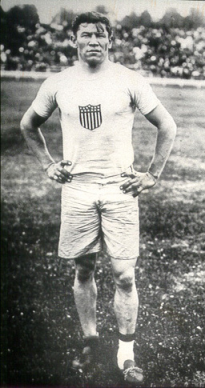
Thorpe was invited to Olympic tryouts, earning a spot on the US Olympic team. Next month he was on another very long journey, this time to Stockholm for the 1912 Olympics. In the span of a few days, he competed in both the Pentathlon and the Decathlon. Many astute sports followers thought he was crazy to compete nearly simultaneously in two such demanding events. Thorpe ended up on the award podium for each; and each time with a gold medal hanging from his neck.
To give the story even more Fairy Tale flair: Thorpe’s track shoes were stolen just as the competitions began. He quickly scrounged around and found two different sized shoes in a garbage bin. He is shown here wearing extra athletic stockings on one foot to make up for the oversize of one shoe. Notice the shoes are different colors, too.

Glenn “Pop” Warner — had coached very successfully at other schools before Carlisle, including Cornell
— Controversy.
An Olympic protest was made in early 1913 — well beyond the 30-day protest period — against Thorpe. His two summers as a semi-professional athlete, it seems, violated the strict “no professional” rules of the day. Although the Olympic rules did not preclude professionals, per se, the Amateur Athletic Union did. And the AAU helped the US Olympic committee and set its rules.
It seems today quite likely that the charge was based on racism. Thorpe wrote a letter to the AAU asking forgiveness:
“I hope I will be partly excused by the fact that I was simply an Indian schoolboy and did not know all about such things. In fact, I did not know that I was doing wrong, because I was doing what I knew several other college men had done, except that they did not use their own names.”
The Olympic records were cleansed of Thorpe’s performance; he was forced to return the gold medals.
Before moving onto Thorpe’s professional sports career, we should put a little more frosting on this Fairy Tale amateur career. In 1911 and 1912 Thorpe also competed intercollegiately in baseball, lacrosse and — extraordinarily — Ballroom Dancing. To burnish Thorpe’s credentials as a true all-around athlete: he was the national college champion in Ballroom Dancing in 1912.
— Professional sports and beyond
Beyond the Edwardian and pre-war years, Thorpe moved on to professional sports: professional baseball, football and (it has recently been discovered) basketball. In his first baseball season, he was on the pennant winning NY Giants and went to the World Series.
Playing pro football since 1913, in 1915 he moved to the Canton Bulldogs in a precursor league to the NFL. They won the championship in 3 of the next 4 years. In the 1919 championship game, Thorpe kicked a 95-yard punt.
As a year-round professional athlete, the toll on his body is unimaginable. He finally retired from football in 1929, at the age of 41.
1929 and the depression era was an unfortunate time to try and find work. Without a pension or any hard skills, Thorpe found work inconsistently and wavered on the brink of financial disaster the rest of his life.
Thorpe’s image and prospects finally turned for the better in 1950, when polls named him “Best Football Player of the Half-Century” and, later, “The Best Athlete of the Half Century.” This is pretty damn impressive. Recognize that his “competition” for this award included Babe Ruth, Jack Dempsey, Jesse Owens, Ty Cobb and Tris Speaker, to name only a few. In 1950 he was also voted into the National Football League’s Hall of Fame.
Thorpe’s health began failing. He had developed alcoholism, his heart was failing and he had lip cancer. He made one last plea to get his medals back. As the New York Time reported:
Impoverished Jim Thorpe, with nothing left but memories at 63, finally swallowed his pride today and asked the Amateur Athletic Union to return the Olympic Trophies it took from him 39 years ago. “I would like to have them back before I die” muttered the erect, massive full-blooded (incorrect, both parents were half caucasian…editorial) Indian, referring to the laurels he was forced to relinquish because the A.A.U, charged he was a professional at the time he won them.”
<
Thorpe never did see his medals again. He died in 1953.
—
But Thorpe had his relentless supporters. Finally, by 1982 the AAU, the USOC and the IOC had all acquiesced. Thorpe’s amateur status and qualifications for the 1912 Stockholm Olympics were retroactively reinstated.
The Gold Medals were returned to his family, accepted by his surviving children, in January, 1983 [3]. The record books were re-written, again; now Thorpe is listed as the co-winner of these events … despite scoring so high in the decathlon that his world record stood for two decades.
— Epilogue and Closing
In polls of sportswriters conducted in 2000, Jim Thorpe was named the Greatest Athlete of the 20th Century.
A 1914 congressional investigation into Carlisle found some abuse of the children and financial impropriety, including over payment of salary to sports coaches. This was a government institution, after all. [6] Pop Warner, in addition to being one of the most creative coaches in history, also gave us the “Football Factory” College. Pretty much what we loathe now about the likes of Alabama, Nebraska, LSU … Warner and other coaches were dismissed, and the school was soon closed and the grounds transferred back to the Army.
May there be a special place in our hearts for those who don’t fit in, who aren’t good students, and who struggle, especially if their struggles aren’t obvious …
Until next time, I wish you peace
Joe Girard © 2014
==> substantially condensed from a short biographical sketch I wrote here ==> Thorpe bio-piece
Resources and citations:
1] http://sportsillustrated.cnn.com/2004/olympics/2004/08/08/bc.olympics.athletics.thorpe/
2] Redskin from Carlisle Will Strive for Place on American Team
http://select.nytimes.com/gst/abstract.html?res=F60C12FC3B5E13738DDDA10A94DC405B828DF1D3
3] http://www.sportshistorytoday.com/jim-thorpe-medals-70-years/
[4] http://www.jimthorpefilm.com/guide/guide01.pdf
[5] Some football records:
http://www.phys.utk.edu/sorensen/cfr/cfr/Output/1911/CF_1911_Team_Carlisle.html
http://www.phys.utk.edu/sorensen/cfr/cfr/Output/1912/CF_1912_Team_Carlisle.html