Tag Archives: Civil War

Cathay

Cathay Williams — Soldier, Ghost, American

Trinidad, Colorado. June, 1891

She had been in the hospital for the better part of two years. The diabetes had taken her toes — not all at once, but one at a time, the way that disease does its work, slowly and without mercy. The neuralgia was constant. Her right ear had gone deaf. The arthritis was brutal. Shrunken lung capacity. She moved on crutches now, when she moved at all.

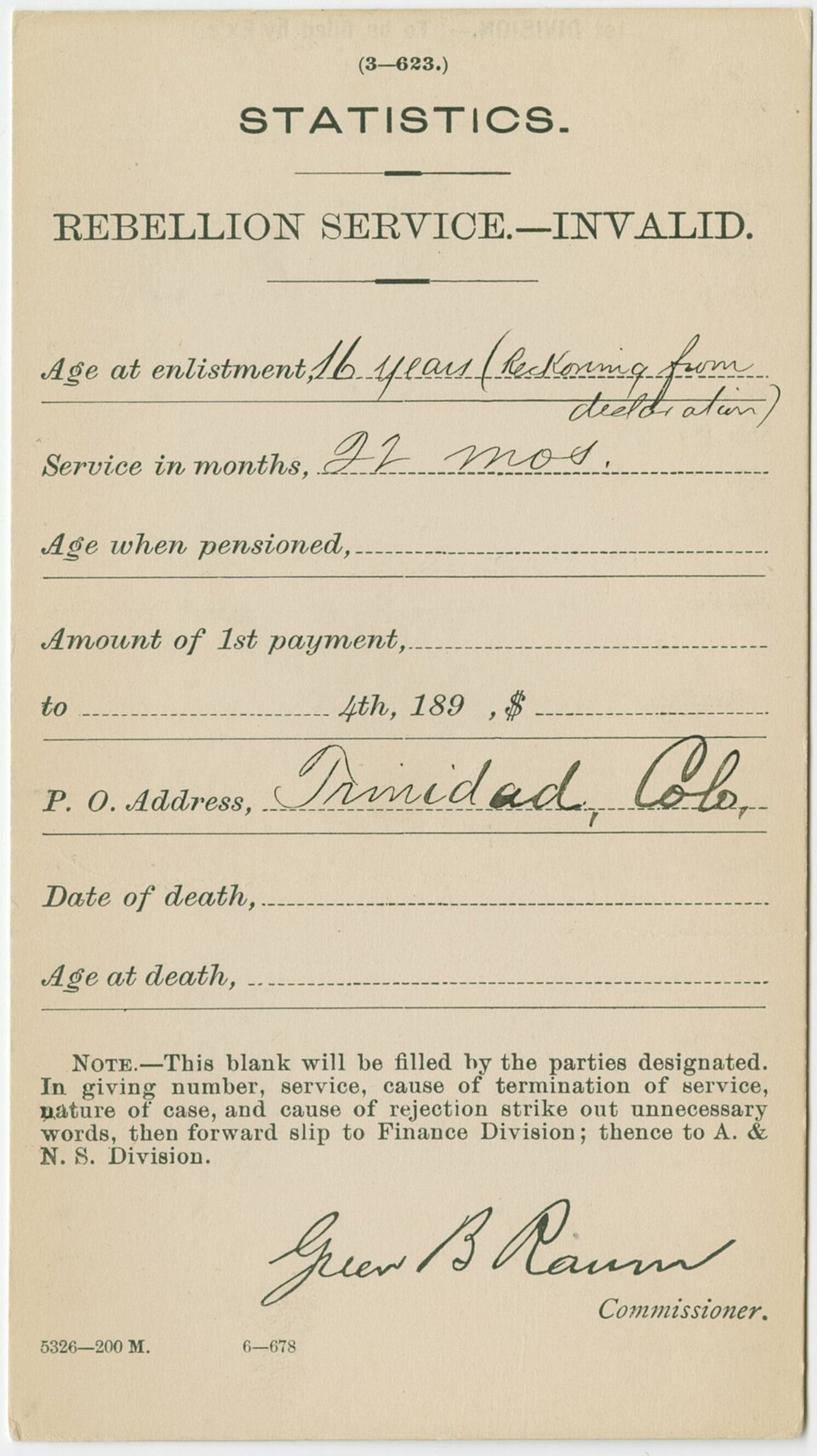
In June of 1891, Cathay Williams made her way to the office of the Las Animas County clerk and swore out a declaration. She was, she stated under oath, one and the same person as Private William Cathay, formerly of Company A, 38th United States Infantry. She had served her country for two years on the frontier. The service had broken her body. She could no longer support herself by the labor of her hands.

She was applying for the pension she had earned.

Then she went home and waited.


Independence, Missouri. September, 1844

Independence, Missouri, sat on the left bank of the Missouri River, at the very western edge of the United States. Founded in 1827 — seven years after the compromise that permitted slavery in Missouri — as the farthest upriver port the steamboats could reliably reach, it had grown from a fur trading outpost into a prosperous, restless town of outfitters, merchants, and dreamers.

Across the river, a ferry ride away, lay unorganized Indian Territory — legally off-limits to white settlement, stretching west into distances no American had fully mapped. From here the Oregon Trail cut ruts northwest along the Missouri toward the Pacific, and the Santa Fe Trail pressed southwest toward New Mexico and the silver trade.

It was into this city that Cathay Williams was born, to a free man [1] and an enslaved woman. Under Missouri law — under American law — the child followed the mother. Her father’s freedom meant nothing to her legal standing. She was property from her first breath.

The law held people in chains.

The Johnson family were slave holders. Their plantation sat just outside Jefferson City, the state capital, some 130 miles to the east — close enough to the seat of Missouri’s government that the ironies were not subtle. Cathay was brought there as a child and worked as a house slave — cooking, cleaning, tending to the Johnson family’s domestic needs. There is no record of what she thought, what she dreamed, or what she endured. Enslaved people were not given the luxury of a written record. We know her name, her approximate birthdate, and where she was held.

We know what came next.


Jefferson City, Missouri. 1861

The Civil War arrived in Missouri early and ugly. The state was bitterly divided — a slave state that never seceded, a place where neighbors shot neighbors and the war was intimate and vicious. In the spring of 1861, Union forces occupied Jefferson City in the war’s opening weeks, sweeping through the state’s capital city with enough urgency that there was little time to sort out the complexities of who was enslaved and who was not.

The Army needed labor. Cathay Williams — seventeen years old, strong, capable — was swept up in that tide. The military classified her, along with other enslaved people taken from Confederate-sympathizing households, as “contraband.” This was the Union’s sanitized legal solution to a problem it hadn’t yet fully reckoned with: you couldn’t simply free enslaved people in a state that hadn’t seceded, but you also couldn’t send them back. So they became property of war. Contraband. Belonging to neither side and to no one.

It was a strange and bitter kind of liberation.

For the next four years, Cathay traveled with Union forces across the full theater of the war. She cooked. She cleaned. She washed. She served the officers of several different regiments — among them the staff of General Philip Sheridan during his legendary Shenandoah Valley campaigns. She marched through Arkansas, Louisiana, Georgia. She was present at the convulsions of the greatest war the young country had ever seen.

She did not march as a soldier.

She was not paid as a soldier.

She was not recognized as anything at all.

The Army moved through her life, and she moved through the Army, and when the guns finally fell silent in the spring of 1865, the United States had freed four million enslaved people and had no particular plan for what to do next.

Cathay Williams was 21 years old, free at last, and on her own.


St. Louis, Missouri. November, 1866

The question that faced every freed Black woman at the end of the Civil War was the same question, asked a thousand different ways: Now what?

The options were brutally narrow. Domestic service. Laundry. Field labor. The same work, for the same people, now technically for wages — wages that were often withheld, docked, or simply never paid. The old order had changed its name. The new one felt remarkably familiar.

For Cathay, there was one institution she knew. One “employer” she had traveled with, marched with, watched up close for four years. The United States Army was hiring. In July 1866, Congress had authorized the creation of six new regiments of Black soldiers — the Buffalo Soldiers, as they would come to be known — to police the frontier, guard the railroads, and push into the vast territories of the American West.

There was just one problem.

Women were not allowed to enlist.

Cathay Williams stood five feet, nine inches tall — well above average for both men and women of that era. She was broad-shouldered and physically powerful, built by years of walking and hard labor. She looked, in the eyes of at least one Army recruiter, like a man.

She reversed her name.

William Cathay
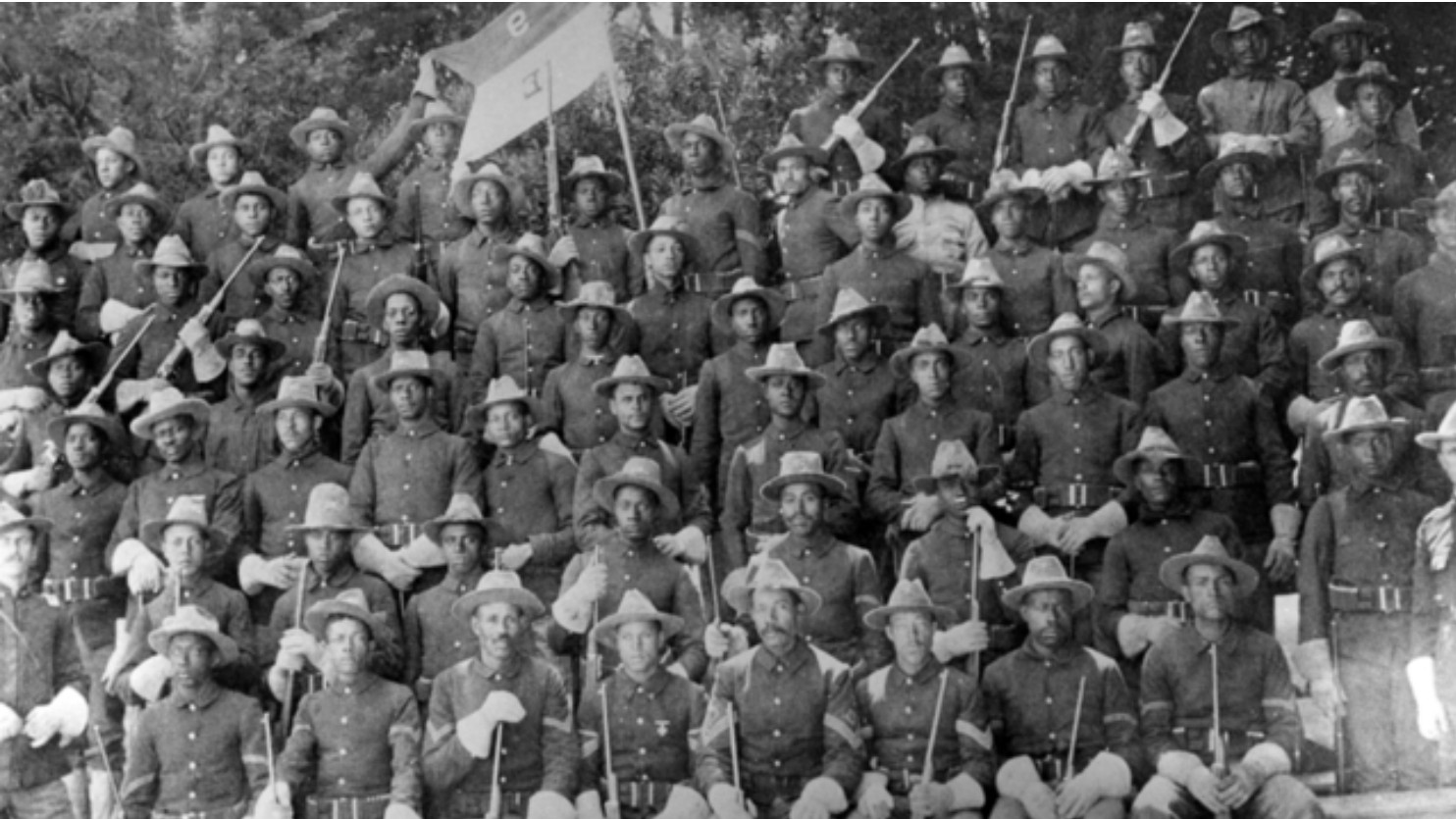
Buffalo Soldiers

On November 15, 1866, at Jefferson Barracks in St. Louis, she submitted to the Army’s cursory medical examination. The doctors were overworked and under-resourced; a thorough physical was a luxury the recruiting office could not reliably provide. The exam passed quickly. William Cathay was pronounced fit for service and assigned to Company A of the 38th United States Infantry.

Two people in the regiment knew her secret — a cousin and a close friend, both serving in the same unit. Both kept their word. [2]

Private William Cathay shouldered a rifle and marched west.


Trinidad, Colorado. February 8, 1892

Eight months is a long time to wait when your toes are gone and the rent is due and all of your joints ache with the pain of thousands of miles of marching through dust.

The letter from the Army arrived in the dead of winter. The pension claim of one Cathay Williams, formerly William Cathay, had been reviewed. The finding: no pensionable disability. The claim was denied.

No one had examined her. No doctor had been sent. A clerk somewhere had looked at the paperwork, made a determination, and moved on to the next file.

She had fought her way across a thousand miles of frontier. She had outwitted an Army recruiting office, two years of bunkmates, and five separate hospitalizations. She was not, by any reasonable measure, a woman who accepted a form letter as a final answer.

She appealed. [3]

And waited again.


The Frontier, 1867–1868

The 38th Infantry moved hard and fast across the American Southwest. Fort Riley, Kansas, then Fort Harker — where a cholera outbreak was already sweeping through the regiment, killing men who had survived the Civil War. The regiment’s march continued regardless: more than 500 miles south and west, down the Santa Fe Trail to Fort Union in New Mexico Territory, arriving July 20, 1867. Then 350 miles more across the New Mexico desert to Fort Cummings. Then Fort Bayard.

One historian estimates that Cathay Williams walked a thousand miles in her two years of service. [4] She walked them in the summer heat of the Kansas plains and the high desert of New Mexico, through cholera outbreaks, through Apache territory, through country that had no patience for the weak or the unlucky.
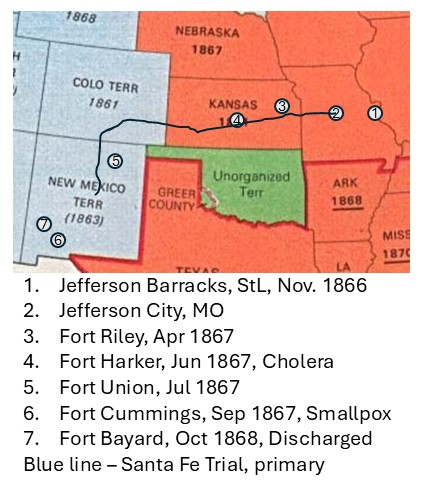
Smallpox found her early. In her own words, she contracted the disease shortly after enlistment, while still in St. Louis, and was hospitalized. She recovered and went with her unit at Fort Riley. But smallpox is not a disease that simply passes and leaves no trace. The virus attacks the bones and the joints — the elbows, the knees, the extremities — leaving behind arthritis, chronic swelling, and in many cases, permanent deformity. It damages the lungs, irreversibly. A smallpox survivor marching through summer desert heat at altitude is marching on borrowed time, with borrowed air. The debt can only accumulate.

Cathay kept up anyway. She drilled. She stood watch. She performed garrison duties. She moved through it all as William Cathay — a quiet, capable private, unremarkable enough to avoid scrutiny, tough enough to do the work. She was hospitalized four more times over the next two years, in four different hospitals, for rheumatism, neuralgia, and what the Army’s records called “general debility.” Not once, through any of those hospitalizations, did anyone discover she was a woman. What that says about the quality of medical care provided to Black soldiers in the frontier Army is its own kind of indictment. Yet, she never complained.

By the autumn of 1868, she was done. The joints. The lungs. The heat. The accumulated weight of two years of frontier soldiering on a body that smallpox had already compromised. She checked into the post hospital at Fort Bayard one last time — and this time, she later admitted, she helped things along.

“I got tired and wanted to get off. I played sick, complained of pains in my side and rheumatism in my knees.”

Consider what that confession contains. She had genuine smallpox damage in her joints and lungs. She had genuine neuralgia running through her nerves. She had two years of desert marching in her legs and compromised lungs in her chest. And she — a woman who had endured all of that in silence — felt she still needed to exaggerate to be believed.

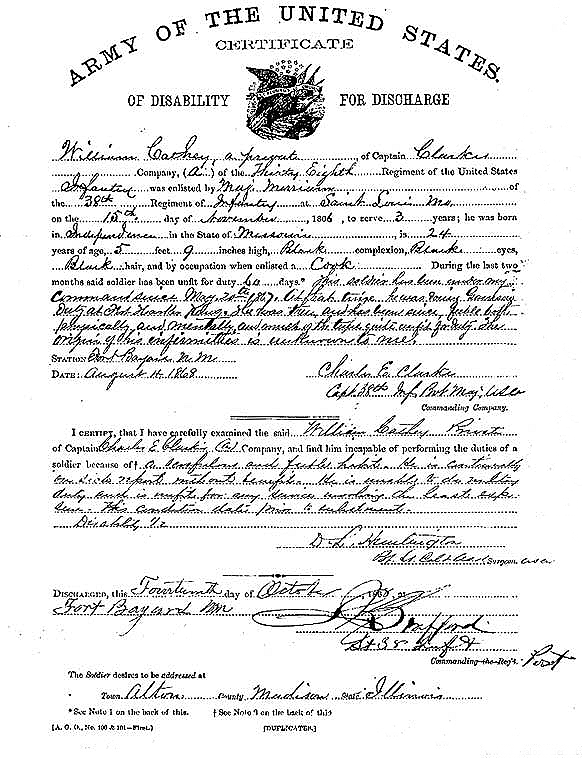
The post surgeon at Fort Bayard conducted a more thorough examination than any that had come before. He found out. He informed Captain Charles E. Clarke, her commanding officer. And Captain Clarke — to his credit — did not court-martial her, did not punish her, did not make a scene. On October 14, 1868, he granted Private William Cathay an honorable discharge on a certificate of disability.

She walked off the post at Fort Bayard on crutches.

She was 24 years old.

Eight years later, speaking to a reporter in Trinidad, she let something out that she had apparently been carrying since that October day on the post:

“The men all wanted to get rid of me after they found out I was a woman. Some of them acted real bad to me.”

It was not a factual account of her discovery — it was the surgeon who found out, and the captain who let her go quietly and with dignity. It was something else. Old anger, finally finding air.


Trinidad, Colorado. September, 1892

He arrived without ceremony — a government doctor, appointed by the U.S. Pension Bureau, dispatched to Trinidad to settle the matter of one Cathay Williams once and for all.

She received him on crutches. There was nothing else to stand on.

He examined her. He saw the amputated toes. The deaf ear. The neuralgia that had been running through her nerves since the frontier. The rheumatism in the knees she had once ‘played up’ at Fort Bayard — and which smallpox had in fact been quietly destroying for more than twenty years. He noted a body that had marched a thousand miles on the damage of one disease and then spent two decades accumulating the rest. He asked his questions. He completed his form.

The Pension Bureau had also written to her private doctors in Trinidad. Those men did not, or could not, provide the bureau with any useful information. She had no one in her corner. Two former comrades — Corporal James Richards and Private James Webster, both of Company A — had submitted affidavits on her behalf, confirming her service and attesting to her disabilities. It was not enough.

The doctor forwarded his findings to Washington.

She waited one last time.


New Mexico and Colorado. 1868–1891

What do you do after an experience like that?

Cathay went to work as a cook at Fort Union, in New Mexico, the place she had marched to in brutal heat less than two years before. She made money. She moved to Pueblo, Colorado. She married — a man who, it turned out, was no man at all. He stole her watch, her savings, a team of horses and a wagon. She had him arrested and jailed. She left Pueblo.

There is something in that detail — she had him arrested — that tells you everything about who Cathay Williams was. Not a woman who accepted being stolen from. Not a woman who disappeared quietly into her circumstances. She knew her rights, and she exercised them, and then she moved on.

She went south and settled in Trinidad, a coal and cattle town tucked into the Purgatoire River valley at the foot of Raton Pass — the same pass the Santa Fe Trail climbed on its way to New Mexico, the same trail she had marched beside years before. To the west rose the snow-capped Sangre de Cristo range. The river running through town the Spanish had named El Río de las Ánimas Perdidas. The River of Lost Souls. She was working as a seamstress.

It seems she may well have owned and operated a boarding house. A laundering and seamstress business. She was building something, slowly, out of the wreckage of what the war and the Army and the frontier had made of her body.

In January 1876, a reporter from the St. Louis Daily Times arrived in Trinidad. He had heard rumors — the story of a Black woman who had served in the Army disguised as a man. He sought her out. He found her. And he published her story on January 2, 1876, in what became the only first-person account of Cathay Williams’s life that history would record.

She spoke plainly, with the directness that had carried her across a thousand miles of frontier.

“I wanted to make my own living and not be dependent on relations or friends.”

That was it. The whole explanation. No grand statement of principle. No claim to heroism. She needed work. The Army was the only work she knew. So she took it.

The story ran. Readers were briefly astonished. Then the world moved on.

By the late 1880s, her body was running out of road. The diabetes was advancing. The smallpox damage she had been carrying for twenty years was now compounding with everything else. The hospital stays grew longer. The crutches became permanent. In June 1891, she made her declaration before the county clerk, put her name to the pension application, and began the wait that would define the last chapter of her life.


Trinidad, Colorado. Winter, 1892

The doctor’s report came back from Washington.

His finding: other than the loss of her toes, Cathay Williams was in good general health. The impairment caused by the amputations was declared permanent, yes — but his disability rating was “nil.” The Pension Bureau accepted his conclusion.

Nil.

The joints that smallpox had been destroying since she was 22 years old. The lungs that had never fully recovered from the disease she had marched a thousand miles on. The knees she had once felt compelled to exaggerate pain in, because the real pain wasn’t considered enough. The body the Army had used and discharged and now declined to compensate.

Nil.

The denial was made not on the grounds that she was a woman and her enlistment therefore illegal — which would at least have had the cold logic of the law behind it. It was made on the grounds that no disability existed. [6] The Army’s own discharge papers, which falsely noted that her “feeble condition” had predated enlistment, were used against her. Her private doctors said nothing. Her lawyers, if she had any worth the name, did nothing. Two loyal comrades had stepped forward, and it had not mattered.

She filed no further appeals. She disappears from the historical record entirely in the months that follow.

It is believed she died within two years of the final verdict.
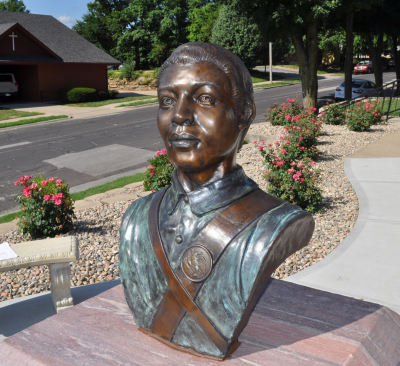
Cathay Williams’ bust–Leavenworth Kansas; Richard Allen Cultural Center

There is no gravestone. The wooden marker, if there ever was one, rotted away long ago. No monument existed until a bronze bust was dedicated in Leavenworth, Kansas at the Richard Allen Cultural Center and Museum in 2016 — 123 years after she likely died.

One hundred and twenty-three years.

The Army she served never paid her pension. The country she served never acknowledged her service while she lived. The frontier she helped tame with her boots and her labor and her silence and her endurance moved on without a backward glance.

What Cathay Williams wanted was simple. To work. To be free. To depend on no one. She got two out of three — the work and the freedom — for a time, and at a price no one who hadn’t paid it could really understand.

The third one, the not depending, she never quite got. Because in the end she had to depend on a government that had used her and forgotten her and sent a doctor with a clipboard and a form to finish the job.

It was a life: difficult, challenging, tragic, inspiring, brief. She asked for little, and got even less.

She deserved better.


Joe Girard © 2026

Thank you for reading. As always, you can add yourself to the notification list for newly published material by clicking here . Or emailing joe@girardmeister.com


Footnotes

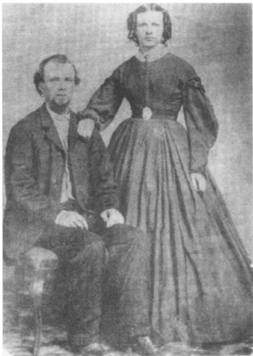
[1] The identity of Cathay’s father is unrecorded beyond his status as a “free man.” In antebellum Missouri, that designation most commonly applied to free Black men, who existed in small but documented numbers in the state under significant legal restrictions. It is also possible — and not uncommon in the slave South — that her father was white, a circumstance that rarely produced legal documentation of any kind. The photographs most widely circulated online as depicting Cathay Williams are of disputed provenance; historians have not verified a confirmed likeness of her. What the record does tell us is that under the legal doctrine of partus sequitur ventrem — the child follows the mother — her father’s freedom conveyed nothing to her. Whatever he was, whoever he was, she was not his to protect.

[2] Only two people in the regiment were entrusted with the secret — a cousin and one close friend, both serving in Company A. Both kept it for two full years. That kind of loyalty, quiet and absolute, deserves its own recognition.

[3] The historical record confirms the initial rejection on February 8, 1892, and the subsequent medical examination in September 1892 — suggesting some form of appeal or review process occurred between the two. No documentation of a formal appeal by Williams has been located, but the sequence of events makes it the most plausible explanation. A woman who had her thieving husband arrested and jailed does not seem like someone who accepted a form letter without a fight.

[4] Historian Phillip Thomas Tucker’s estimate. The 38th marched from Fort Riley to Fort Harker to Fort Union to Fort Cummings to Fort Bayard — across Kansas and deep into New Mexico Territory — over the course of two years of service. Five hundred miles from Fort Harker to Fort Union alone, in the summer of 1867.

[5] The pension denial was made on the grounds that no disability existed — not on the grounds that her enlistment was illegal because she was a woman. There was precedent for granting pensions to female soldiers: Deborah Sampson (1816), Anna Maria Lane, and Mary Hayes McCauley — better known as Molly Pitcher — had all received pensions for Revolutionary War service. The Pension Bureau chose the least defensible grounds available and used them anyway.

[6] The process Cathay Williams navigated was standard procedure for the era — file a declaration, wait for the War Department to verify service records, receive a paper determination, then submit to a physical examination if the claim advanced. What was not standard was her odds. By 1893, more than 900,000 persons were on the pension rolls, consuming the largest single line item in the federal budget. The Bureau was under intense political pressure to control costs and root out fraud, employing hundreds of special examiners specifically to find reasons to deny claims. Into this system walked a Black woman with an unusual claim — and the system had well-documented tools for handling that. Scholarly research has established that local physicians rejected Black veterans’ applications at higher rates than white ones, and that Washington officials compounded the discrimination, developing what one study described as a bias against the “downtrodden races.” The initial paper denial before anyone examined her was not neglect — it was procedure. The “nil” disability rating after examining a woman on crutches with amputated toes and twenty years of smallpox damage was not an oversight. It was the system working as designed, for the people it was designed to serve. Cathay Williams was not among them.


Author’s Notes

  1. The primary source for Cathay Williams’s own words is the St. Louis Daily Times interview of January 2, 1876. It is the only first-person account she ever gave. The ‘played sick’ quote and the ‘men acted real bad’ quote both come from this interview. The first is a confession of exhaustion; the second is old anger, finally finding air.
  2. The pension file — including the February 1892 rejection and the September 1892 medical examination — survives in federal records. The doctor’s ‘nil’ disability rating is documented. The affidavits of Corporal James Richards and Private James Webster are part of the same file. No written explanation for the final denial survives beyond the finding that she “did not qualify.”
  3. Sources differ on exact dates of birth (1842, 1844, or 1848 appear in various records), and on the precise timeline of her post-Army life. I have used the dates most consistently supported across multiple historical accounts. She disappears from Trinidad census records after 1892, suggesting she died before 1900.
  4. The life of Cathay Williams is most thoroughly treated in Phillip Thomas Tucker’s biography: Cathay Williams: From Slave to Female Buffalo Soldier (2002). The buffalosoldier.net archive, which reproduces and annotates the original pension file documents, was invaluable in reconstructing the pension denial sequence.
  5. This essay was researched with the assistance of Claude, an AI developed by Anthropic. Claude was also used for editing. The historical judgment, structure, voice, and final text are completely the author’s.
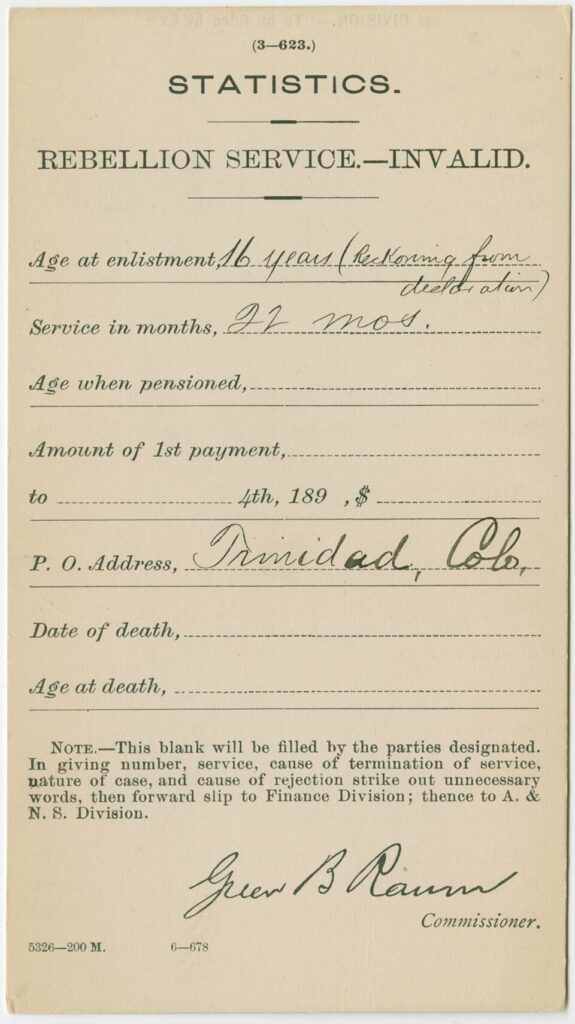
    Pension rejected
Abbie-Heroine of Iron

Abbie, Heroine of Iron

On a frigid December night in 1862, with single-digit air borne on the winds of a howling blizzard, a seventeen-year-old girl held the fate of the Union in her frostbitten hands. Inside the small station at Port Perry, Pennsylvania, the telegraph sounder began clicking frantically—a staccato rhythm of pending doom for Lincoln’s top generals. Before the last “clack” of the message finished, Abbie Gail Struble was out the door.

__________________________________________________________________________________________________________________

Abbie Gail Struble was born on April 22, 1845, in Perrystown, PA, the third of eight children born to George Lewis Struble and Margery (Gregory) Struble.

Perrystown, situated some 12 miles southeast of Pittsburgh, was founded in 1790 by John Perry, its location chosen for the convenient confluence of Turtle Creek with the Monongahela River.  From there farmers could ship their grains, and loggers could float their timber, down to Pittsburgh. And from there, perhaps even as far as New Orleans.  But these were low-capacity flat bottomed boats: the river was too mercurial, going from a lazy shallow stream to bellowing beast in the spring. The low-draw boats could make it through the shallows, and over rocks—with a skilled pilot.

The 1836 charter of the Monongahela Navigation Company presaged the end of Perrystown’s isolation. By 1841, the completion of the second of seven planned locks transformed the quiet settlement of eight families into Port Perry. The river was no longer a shallow obstacle; it was a highway for deeper-draw vessels plying the waters in both directions.

While the Monongahela Navigation Company was taming the water with hand-hewn stone [1], a different kind of current was arriving in Allegheny County—the telegraph.

In 1845, the year of Abbie’s birth, the first commercial telegraph poles were already marching across the American landscape. It had been just one year since Samuel Morse tapped out his historic first message, “What hath God wrought?” By the time Abbie was old enough to walk the wharves of Port Perry, the rhythmic “clack” of the telegraph was already competing with the roar of the riverboat whistles and the thump of paddle wheels.

This new technology soon found its permanent partner in iron. In 1851, the Pennsylvania Railroad reached the town, hugging the riverbanks leveled by the Navigation Company’s earlier work. To maintain a level grade, the tracks followed the river’s bend, along the right bank, downstream toward Pittsburgh, at one point piercing a rugged hillside via a dark, narrow tunnel. The rails and the telegraph arrived as a pair; in those early days, one simply could not exist without the other.

Abbie’s father, who went by Lewis, arrived from Germany in 1836 as a healthy young man. Drawn to Port Perry’s labor market, he spent his early years as a “Laborer” on the river navigation works and the wharves. Eventually, he became a “pilot,” mastering the seasonal currents and hidden rocks of “the Mon.” When the PRR arrived, Lewis saw a way out of backbreaking labor. He mastered the telegraph code and was hired by the railroad. [2].

Telegraph Sounder

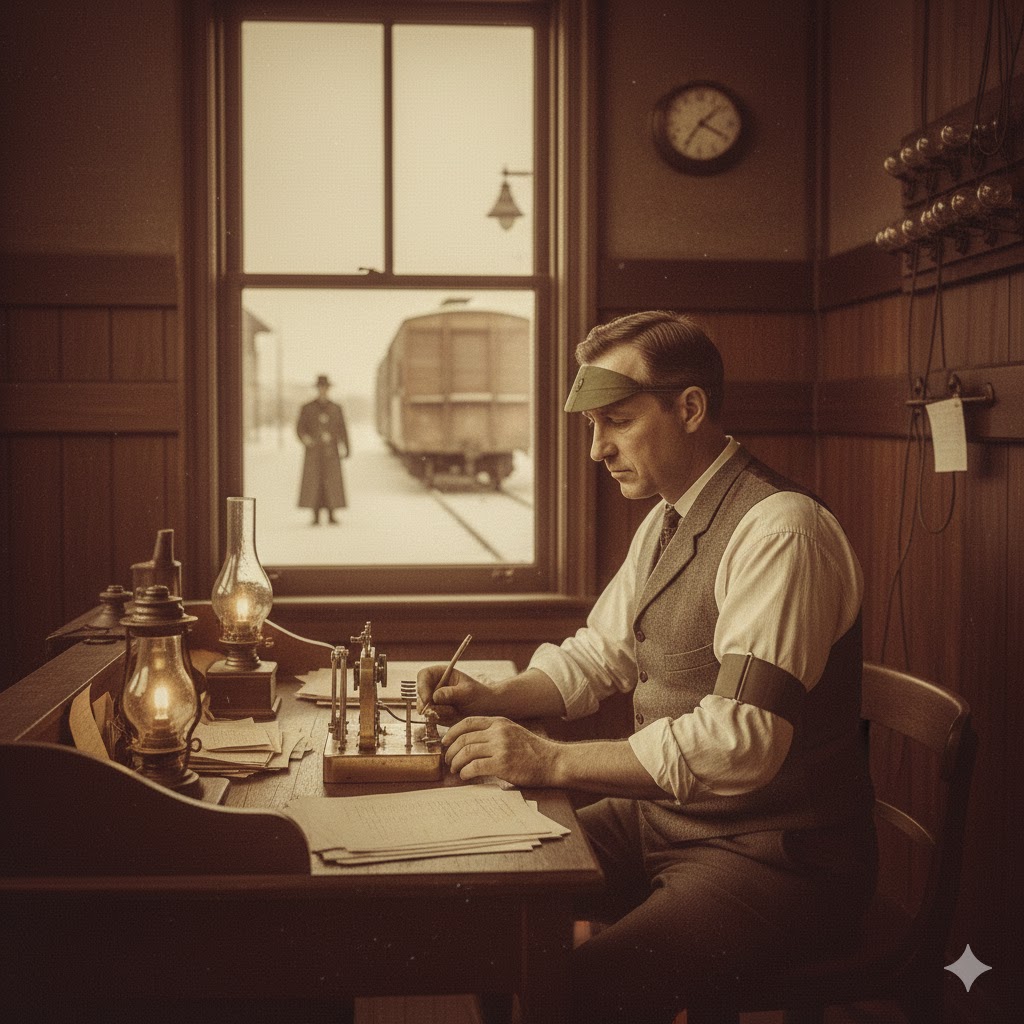
Lewis didn’t just learn the code; he brought it home. Because of the job’s importance, telegraphers often lived in or alongside the station. In the crowded Struble household, the staccato rhythm of the telegraph became a second language. While other girls practiced needlepoint, Abbie and her sister Madge (younger by two years) mastered the “sounder.”

At the time, most operators were still “readers”—they relied on a machine to emboss the code onto long strips of paper tape, which they then transcribed into letters, then into words. But the Struble girls were “hearers.” They developed the rare ability to translate the metallic clicks made by a sounder, essentially a metallic bell, into English in real-time, purely by ear. This skill made them faster, more accurate, and—by the time the Civil War arrived—indispensable. [3]

In 1861, Abbie and Madge, and close friend Anna Bellman, went off to the Pittsburgh Female School (now Chatham College) to get official training and certification in telegraphy.

There was great reluctance to hire women as telegraphers.  But eventually many were hired: the need for telegraphers trumped the issue of gender. Soon the PRR hired Lewis’ two gifted daughters.  They all worked at the telegraph station and house – keeping it manned 24/7.

By mid-December 1862, the Union was bleeding out. The year had begun with hope for a quick resolution, but the reality was grimmer. A string of losses was followed by the Pyrrhic victory at Antietam—the deadliest day in American military history, a slaughter that left the Army of the Potomac shattered. [4]

Seeking a turning point, President Lincoln pressured his newly appointed head of the Union Army, Ambrose Burnside, to be more aggressive. Burnside obliged, launching a massive assault against Confederate forces at Fredericksburg, Virginia, on December 13. It was a disaster in every regard. Despite possessing far superior numbers in troops and cannons, Burnside blundered, sending his men into a meat-grinder. The Union suffered twice as many casualties as the Confederates. By the 15th of the month, Burnside and the remnants of his army withdrew, a movement that sent ripples of panic and reorganization northward through the rail hubs of Pennsylvania.

News of the loss devastated moral across the north, from the military, to the government and especially to the public, who nearly lost all faith in the effort … and in Lincoln.

The Strategic Pivot: the Generals went North, to Pittsburgh

The disaster at Fredericksburg had done more than just deplete the Union’s ranks; it had paralyzed the Eastern Theater. With the Army of the Potomac in shambles and the Baltimore & Ohio Railroad—the Union’s primary southern artery—clogged with wreckage and vulnerable to Confederate bushwhackers, the North was forced to pivot. Pittsburgh became the essential “Safe Harbor.” Situated safely behind the Allegheny Mountains, it was the only major industrial hub that could refit an army without fear of Lee’s cavalry. High-ranking generals and their staffs were pulled north to Pittsburgh to coordinate the “Westward Shift,” as Lincoln began to look toward the Mississippi River and the rising star of Ulysses S. Grant to salvage the war effort.

telegrapher in small rail station

Beyond strategy, there was the sheer gravity of the “Iron City.” Pittsburgh was the Union’s arsenal, producing the massive Rodman cannons and the iron plating for the river monitors that were winning the war in the West. In December 1862, the rail lines through Port Perry were thick with “Military Specials”—ghost trains carrying generals for secret war councils at the Monongahela House or overseeing the emergency transport of heavy artillery. These trains moved with a frantic, unlisted urgency. They were the “invisible” traffic of the war, and on a single-track line, invisibility brought potential for catastrophe.

The Monongahela House was the premier hotel in Pittsburgh; it became the “situation room.” Burnside, Grant and many top generals stayed there. Even Lincoln visited once, in February 1861, on his way from Illinois to his inauguration.

Military traffic was heavy through tiny Port Perry: troops, armaments, iron.  And of necessity, so was the telegraph traffic. The Struble girls were often privy to very classified information as they read and relayed important telegrams.

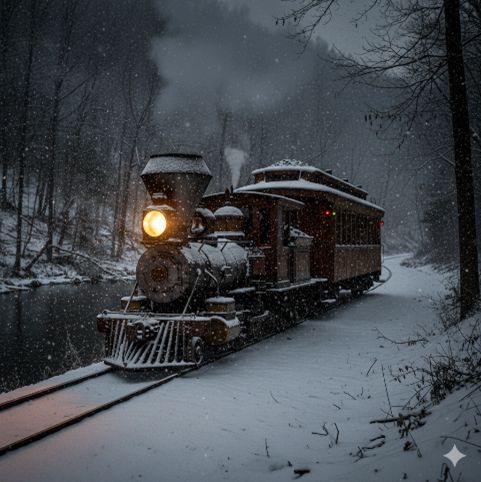
Many of the military trains were “ghost trains”, born from the need for secrecy they weren’t shown on any schedule. They were called “Extras”.  Telegraph was sufficient to notify stations along the way, often with little warning, that the track must be cleared using sidings and switch yards at stations. Such was the status of the late December train headed for Washington, carrying all of the Union’s top generals who had been urgently summoned by President Lincoln.

________________________________________________________

Nothing—not a train nor any packet of information—went through Port Perry without at least one of the Strubles knowing it. They were now an extremely critical link in the battle to end slavery and keep the young nation of 86 years united.

On a bitter cold December night Abbie received a message that a locomotive carrying a single car had rumbled out of Pittsburgh, carrying the generals and top officers to an emergency conference with the President.  An extra.  A ghost train.

As researcher Chris Enss writes:

“At the same time, a west bound freight train pulled into the depot
fifteen miles east of Port Perry. The conductor of the west bound train
entered the telegraph office and asked for track clearance to
Pittsburgh. The message was relayed to the train dispatcher, and the
‘all clear’ reply came back.”

All seemed as it should be as the freight train departed toward Port Perry. It chugged steadily into the storm, a heavy chain of iron pushing through the gale and snow. Though the blizzard forced a cautious pace and choked the engineer’s view with snow, the train’s burdensome weight gathered a cold momentum as it pushed along the tracks bordering the river.

Unexpectedly, Abbie heard the sounder clacking frantically—a frenzied message from the dispatcher who had given the “all clear” just minutes before. He had only just learned of the ghost train from Pittsburgh. It was too late for him to intervene; he could only hammer out a desperate warning down the wire.

A head-on collision was imminent.

Abbie didn’t hear clicks or individual letters—she heard words. Every second saved by her “hearing” was invaluable. She looked out the station window and realized she had only heartbeats to act. Through the swirling snow, she saw the freight train’s headlight already cutting through the station yard. No use and no time to put up the station’s stop signal.

—–

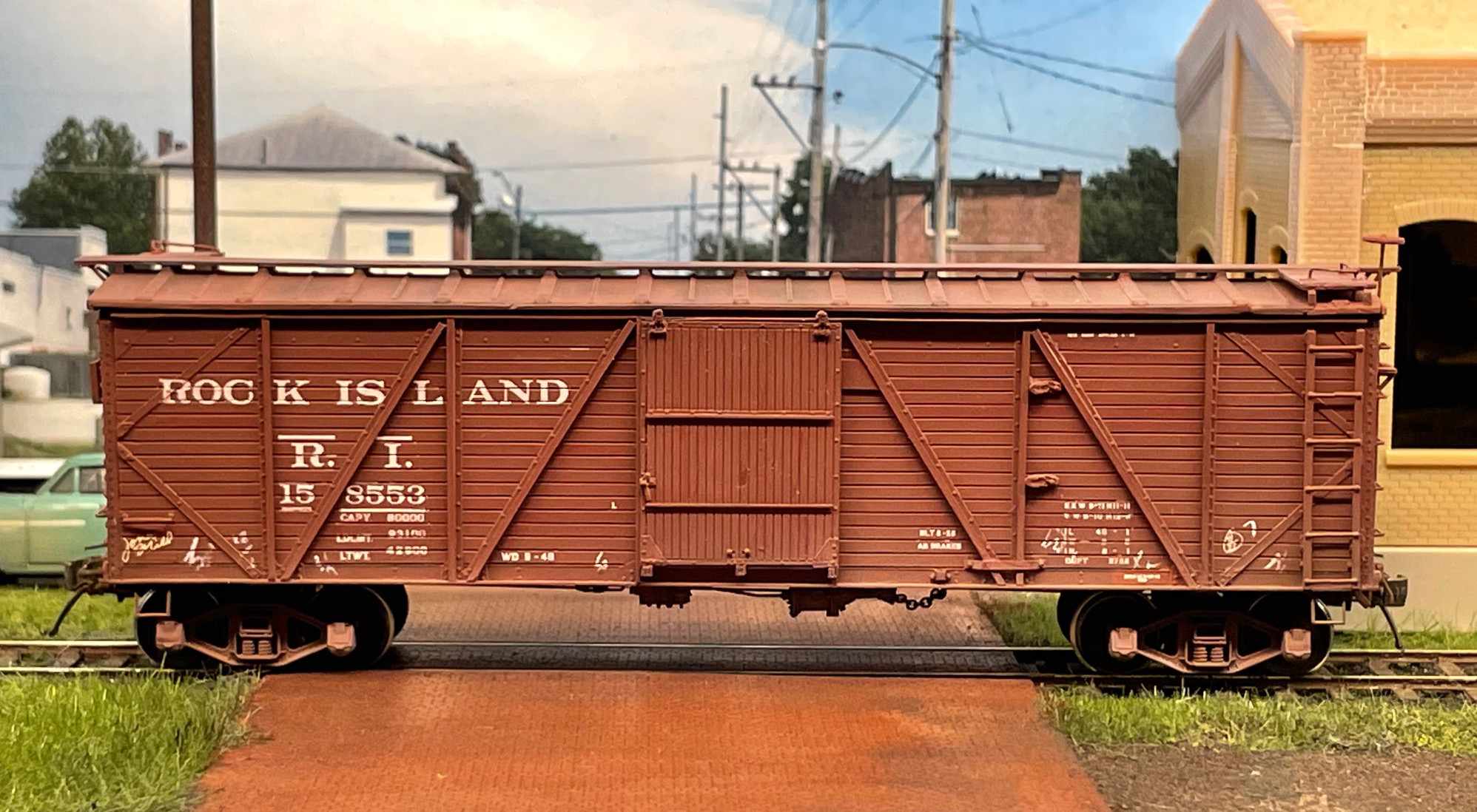
Abbie plunged into the blizzard, the brutal cold and wind shocking her senses, snatching her breath. She sprinted along the snowy platform, matching her stride to the train’s grinding pace before she leaped. Her fingers locked around an iron “grab bar” at the front of the first boxcar, just behind the tender. The train jerked her violently, nearly tearing her arms from their sockets. Though the iron was slick with ice, she held fast, kicking for balance as the locomotive pulled her away from the safety of the station and into the dark.
Creeping Freight
Even in clear weather, trains often slow to a crawl near stations and yards to navigate switches and signals, even when there is no stop scheduled. When heavy snow hits, visibility and friction drop sharply. Engineers must then drop to a “Restricted Speed”—often under 5 mph—ensuring they can stop within half the distance they can see, an operational requirement.

With herculean determination, she swung her weight toward the ladder, her boots scraping for purchase against the vibrating iron. Hand over hand she went, up the rungs. At each rung her fingers flash-froze to the metal, pulling off flecks of skin with each release, but she didn’t slow. The biting cold was now a part of her, a raw and bloody price for every desperate inch.

Her path to the engineer was blocked by two daunting barriers: the yawning, shifting gap between the box car and the tender heaped with frozen coal. As the train banked along the river’s curve, the coupling between the boxcar and the tender groaned and clattered—a jagged jaw of moving metal that threatened to swallow her. Second, how to get across the mound of coal in the tender.
Author note
While the specific mechanics of Abbie’s transit from box car to across the coal tender are not detailed in contemporary accounts, they are creatively synthesized here based on the physical layout of the 1860s rolling stock and the known outcome of her arrival in the engine cab.

Box car–ladder and rungs at one end

This region of the train was one of the most vibrationally violent. Even with the locomotive moving slowly due to reduced visibility, the heavy cars groaned as they followed the river’s turns. They didn’t just roll; they lurched and shuddered, turning the simple act of standing into a fight for survival.

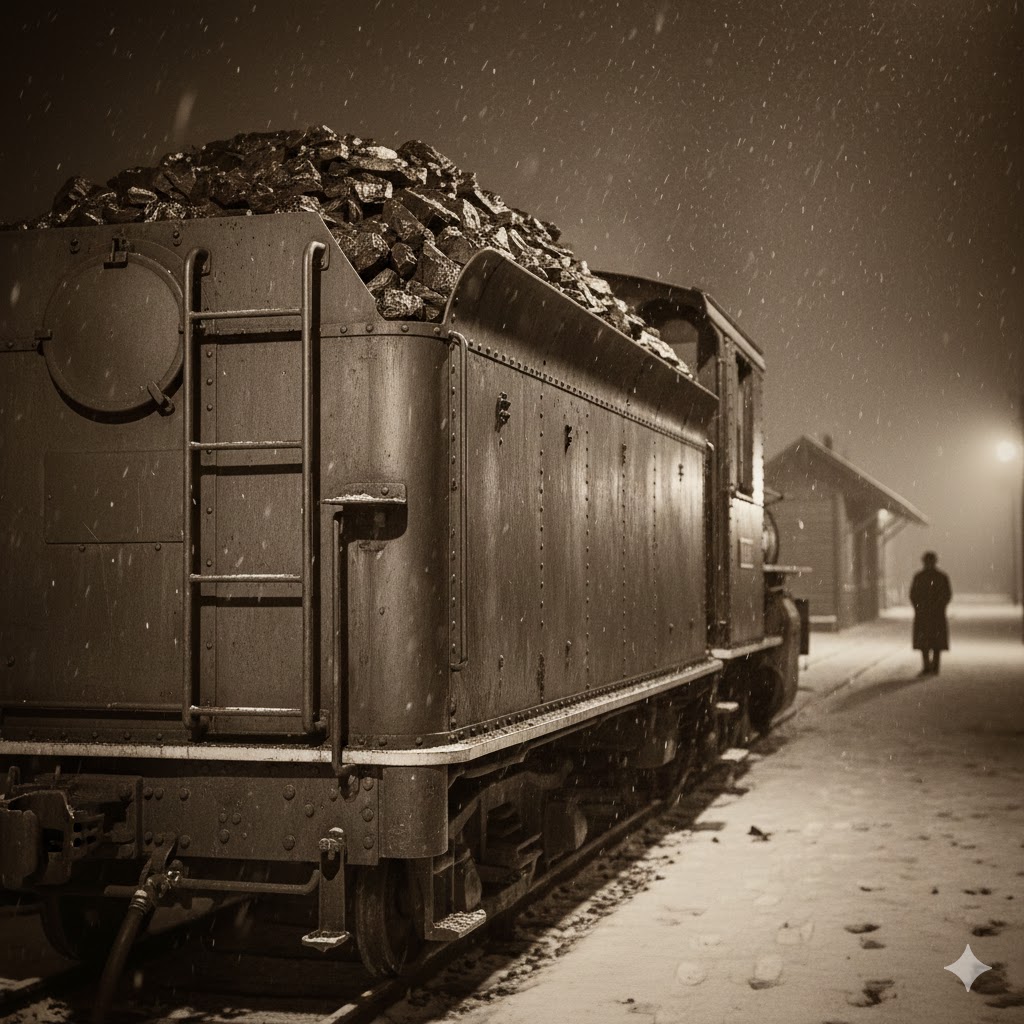
Tenders of that era had a ladder at their aft end—a vertical string of iron “stirrups” set off-center. Abbie edged to the far fore of the boxcar rungs, the freezing wind whipping her skirts as she prepared for the leap. Trailing soot and sulfurous smoke from the locomotive choked her, but her focus remained sharp.

With her left hand anchored, she reached out diagonally, her right arm and leg fully extended over the “jaw” of the coupling. The gap to the tender stirrups was a terrifying three-and-a-half-foot void of rushing darkness and vibrating iron. With courage beyond imagination, she released her certain grip on the boxcar and threw her

1860s Tender with rear ladder

weight into the storm, her fingers clawing for the icy rungs of the tender.

With frostbitten, de-skinned fingers, Abbie reached the top of the tender. The coal was heaped high and slick with snow. Just as she pulled herself over the edge, gaining some traction on the coal, a tremendous whack struck her leg, nearly pitching her into the fatal oblivion of the tracks below. It was the “tell-tales”—the heavy, knotted ropes hanging from the gallows-arm above—warning that the train was entering the tunnel.

She dropped instinctively to a crawl as the world vanished into a suffocating, pitch-black void. Inside the tunnel, the locomotive’s smoke was trapped, funneling directly into her lungs while tiny hot cinders stung her face. She scrambled blindly over the frozen mounds, the sharp corners of coal piercing her raw palms and knees. Every breath was a struggle against the soot, yet she pushed forward until she reached the tender’s foremost end, where the orange glow of the firebox finally flickered through the dark.

From the station door to the front of the tender had taken twelve grueling, painful minutes.

Below her, two firemen labored in the “hell-gate” of the footplate—blistering hot from the furnace on one side, literally freezing from the blizzard on the other. Abbie was at her physical limit, her strength spent. She tried to scream, but the cacophony was absolute: the rhythmic pounding of the cylinders, the grinding of the massive drive wheels, the rattle of the links, and the roar of the storm swallowed her voice.

In desperation, she grabbed a frozen lump of coal and hurled it.

“What the—?” A fireman recoiled as a chunk of coal struck his shoulder. He looked up, expecting a shifting load, but found instead the ghost of a frozen girl peering down from the rim of the tender. Through frantic, blood-smeared gestures, she signaled the danger ahead. Startled, he reached up and hauled her down to the vibrating floor, where the heat of the firebox met her frozen resolve. It was only then, as she gasped for air, that they learned the true urgency of her mission.

The engineer threw the heavy Johnson Bar into reverse. Despite the slick rails, the train ground to a halt; their cautious speed through the blizzard had left them with much less momentum than if the weather had been fair. He opened the “sander,” dropping just enough grit onto the iron rails to find the static friction needed to get purchase, and retreat.

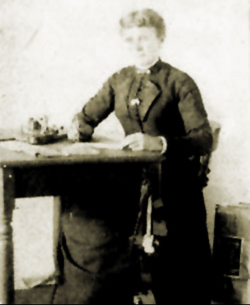
Abbie, later years, perhaps early 1900s

The locomotive pushed backward through the storm as fast as the engineer dared, covering nearly 2 miles back to Port Perry in a desperate race against the clock. He knew track was clear; and made good time. As they entered the station yard, a crew man climbed down and pulled the switch. The train moved to a sidetrack, then the switch was reversed. A few minutes later, the express train carrying Lincoln’s generals whooshed by—a ghost of steam and metal heading east toward Washington.

Abbie’s unique talent—her ability to “hear” the words in the sounder while others were still transcribing—had bought her precious seconds. If not for that, she wouldn’t have caught the first box car, and her scramble to the engine cab would have been taken too long, and probably impossible.

But that skill would have been meaningless without her staggering bravery and athleticism. In excruciating pain, lungs filled with smoke, snow and charcoal dust, and in the very face of death, Abbie Gail Struble had saved the leadership of the Union Army. It is a chilling exercise to imagine the course of the Civil War had she stayed by the warm stove in the station.

____________________________________________________________________________

On May 24, 1866, Abbie married a telegraph lineman named John Vaughan. Under her expert coaching, John mastered the art of reading the sounder, and together they joined the great westward expansion of the railroads. Their skills took them across the continent—from the plains of Texas to the Mexican National Railroad and many other locales—as they raised five children. In a fitting tribute to their mother’s legacy, all five went on to become telegraphers.

Young Abbie and John Vaughan, perhaps wedding shot

They eventually settled in Long Beach, California, where Abbie became a renowned teacher of the craft. Though she retired in 1913, her country called upon her once more in 1917. At the age of seventy-two, as the nation entered the Great War, Abbie returned to work for the Army to train a new generation of recruits. By then, she was known affectionately as “Mother Vaughan,” the Mother of Code Telegraphy.

Abbie passed away on September 17, 1924, age 79. Her husband, John, had passed a few years before, on June 23, 1921. They are both buried at Sunnyside Cemetery, in Long Beach, Ivy plot, lot 86. Sadly, her younger sister, Margery, “Madge”, Abbie’s equally skilled sister, passed away in 1894 after a brief illness

Though her heroism was documented in the regional press of the 1860s, her story resonated for a century, culminating in a major retrospective in the Los Angeles Times on May 5, 1958, which sought to preserve the legacy of “The Girl of Port Perry” for a new generation.

History is often loud in its moments of crisis but silent in its gratitude. While no official medal commemorates that night in the blizzard, Abbie built a prize far more lasting: a legacy of communication that resonated for a century. On the “Right Bank” of history, she remains the girl who heard what others couldn’t, and did what others wouldn’t.


Joe Girard © 2026

Thank you for reading. As always, you can add yourself to the notification list for newly published material by clicking here . Or emailing joe@girardmeister.com

Footnotes:

[1] Stone.  The entire project was done by hand: hard labor.  Hand hewn stone from local quarries was used to build the dam and the line the locks.

[2] a) his name was probably Anglicized from Georg-Ludwig Strubel. (b)Germany was not a country until 1871. In at least one census report he is from Baden, a principality that contained Heidelberg, Freiburg, and Mannheim.

[3] Sounders were still somewhat rare at that time, but they were becoming more and more common, especially as the war dragged on. And rail traffic increased. The need for speed.

[4] On that single day, September 17, 1862, nearly 3,700 lives were lost in battle, more than The War of 1812, the Mexican-American War, and the later Spanish-American War COMBINED. Total casualties that day were over 22,700 men.  D-Day (June 6, 1944) came at a price of 2,500 US lives; Pearl Harbor (Dec 7, 1941) took 2,400.

Author’s notes

  1. I first found this story in a book by Chris Enns called Iron Women.
  2. Descriptions of Annie’s heroic acts are somewhat thin. One has very little heroism, she merely stopped the train. Others are tauntingly more thrilling. There aren’t many descriptions. It’s been generally reported that she (1) leaped onto a box car (2) scrambled to the “coal car” (3) was hit by tunnel’s tell-tale rope, and (4) alerted the firemen. That’s all.
    So … the details from leaping to the first set of grab bars until she notified the fireman are all conjecture by the author. I spent time learning of and reviewing box car and tender car designs, studied train speeds in stations with switching yards, and how snow and moisture affected the tracks.
  3. Port Perry no longer exists. The junction of Turtle Creek and the Monongahela is a large rail yard, mostly supporting the US Steel Edgar Thomson Works.  Before this, Perrystown was sometimes called Perriestown.
  4. Abbie Gail was often referred to as just Abby, or Abigail.
  5. One source says that George Lewis Struble was of German descent. One says he was from Germany. In the 1880 census he claimed to have been born in Baden (which became part of Germany). Madge, still living with her parents, as a Telephone Operator.  But other sources have her a telegrapher.  Phones were quite new and even rare, but it’s sure possible.

    50th Anniversary pics

    Family reunion, circa 1920

Part III – It Happened First In …

A House divided against itself cannot stand”

Abraham Lincoln,
quoting Jesus of Nazareth,
June 1858 speech accepting his party’s nomination for Senator of Illinois, 1958

Lincoln, pre-           beard

Set within a glacially-crafted landscape, as is Part 2’s Waubeka (which is a scant 50 miles southeast) one finds our third and final small community of this trilogy: the hamlet of Ripon.  As with the communities of Parts I and II of this trilogy, Ripon sits alongside a trustworthy clean source of flowing water: Silver Creek.

Driving to Ripon from any direction, whatever the season, one is mesmerized by the views of fields reaching to the horizon, over subtle ground bulges that pass as rolling hills.

Such drives can be exercises in boredom or awe, depending on point of view.  The country-side landscape surrounding Ripon certainly looks bucolic; that’s deceptive: whether it’s crops, livestock or dairy, Ag life is hard.
In mid- to late summer the fertile expanse stretches ever onward, bedecked with maturing crops, interrupted only by the occasional farmhouse, an array of grain silos or a dairy farm.  Trees are sporadic, and usually betray some feature of the land.

Betrayal: A woven garland of trees, sidling and twisting along, betrays a creek in a hidden draw.  A hedge of trees: a property or acreage boundary.  A sparse grove scattered across a small area: a farmhouse.

Most acreage is corn, but there’s also plenty of soybean and cattle fodder, such as the legume, alfalfa, and hay bearing grasses.

The landscape can be equally mesmerizing the rest of the year, too. In winter some crop rotation is needed for soil health and protection; that’s mostly winter wheat, planted in early fall so that germination happens before the first deep freeze. But many of the endless fields simply lie in slumber, carpeted under innumerable 6-sided crystals of white moisture through the weeks, as calendars are flipped from November to March. [1]


The first white settlers arrived in the area in 1844, from New York, via Sheboygan. Inspired by the writings of French philosopher Charles Fourier, they intended to build a utopian agrarian socialist commune, withdrawing from the developing American dog-eat-dog culture. They chose well: glacially blessed fertile and moist prairie land, at the confluence of the smaller Crystal Creek with Silver Creek. These idealists called their settlement Ceresco, after Ceres, the Roman goddess of agriculture.

There are few secrets when it comes to great places to settle. Soon after the Ceresco settlement, David Mapes, also originally from New York, arrived.  Finding the setting as a potentially commercially attractive site, he envisioned a community adjacent to Ceresco, just spitting distance to its east (especially with the prevailing westerlies).

Mapes soon entered into an agreement with the owner of this large swath of land along Spring Creek – a chap named John Horner – for the development of a city there. Horner decided the new community should be named Ripon, after his ancestors’ hometown, Ripon, in England’s North Yorkshire County. As Mapes also had ancestry from England, there was no objection.


Before long Mapes had completed a dam on Silver Creek. This was significant. The dam enabled the creek to power a mill. The dam also formed a large pond. Both the mill and the pond promoted commercial and community development. The mill would grind grist into meal. By virtue of Ripon’s trustworthy long, deep, cold winters, the pond provided ice. The ice was harvested in early spring. Thence it was stored in ice houses and cellars, insulated under layers of hay and sawdust. Through the warmer months it was used to chill and preserve foodstuffs, dairy products, and beer. Such was life before refrigeration. At least there was cold beer.

Within a very few years Ripon was thriving. It was growing. Over those same few years, many in the Ceresco commune began struggling with the idealistic concepts and practices required for total collectivism. As land values increased many wished to sell out.  Some found a way to do that.  Many became Forty-niners and drifted away to follow the Siren call of gold and fortune.  Ceresco was absorbed into Ripon.


“[The Confederacy’s] foundations are laid, and its cornerstone rests upon the great truth: that the negro is not equal to the white man; and that slavery — subordination to the superior race — is his natural condition. This, our new government, is the first, in the history of the world, based upon this great physical, philosophical, and moral truth” 

Alexander Stephens,
Vice-President CSA,
Cornerstone Speech, 1861

Alexander Hamilton Stephens, VP of the Confederate States of America

Things were neither mesmerizing, nor beautiful, nor bucolic in America in these, the fledgling years for Ripon and much of America’s heartland. The issue of slavery was about to rend the nation asunder. [edited later: OK Lee Webb, and cotton tariffs].

In the supposed “two-party system” America sorely lacked a strong second party. The Democrats had held sway from Jefferson (1800) until 1840. In the ‘30s a new party, the Whigs, coalesced around a single notion: presidents (as exemplified by Andy Jackson, often described as a jackass — a label he gladly accepted) were too powerful. Beyond that notion — that Jackson was a jackass (which later became the Democratic symbol, a donkey) and too powerful as an executive — the Whigs were little more than a loosely cobbled-together coalition.

In 1840, with William Henry Harrison, the Whigs finally wrested the White House from the Democrats. But WHH promptly died, only a month in office, leaving the office to Tyler (“too!”). Sadly, he had strong “states’ rights” leanings, and, thus, implicitly, pro-slavery inclinations. Harrison’s only major policy initiative was to re-create a national bank (which had been scuttled by Jackson); but when it passed Congress it was vetoed by Tyler. The US financial system would remain fragile.

Thus, with Harrison’s passing and Tyler’s ascendence, the Whig fracture began – which soon led to their demise. They did win one more presidential election, in 1848, with Zach Taylor (probably a good general and poor politician), but he also died in office. Fillmore inherited the presidency. He was in practice pro-slavery (signing the horrific Fugitive Slave Act and denying that the government had any power to end slavery). He was, of course hated by northern Whigs. The party’s factions drifted irreversibly apart. Totally useless, it soon died.

In the 1850s the Democrats, were also split over slavery; the significant factions all favored maintaining slavery. Oversimplified? Sure. Some wanted to expand it to new territories, and others wanted the new territories (which would inevitably become states) to decide for themselves. Across the factions they agreed with the Whig, Fillmore: the federal government had no authority to end the awful institution. Whatever the national policy: slavery should remain forever in the South.

It was dire times for both abolitionists and those who wanted to stop the expansion of slavery. In 1853, the Kansas-Nebraska Act, powered by a Democrat coalition, was thundering down the pike. To Anti-Slavers and Abolitionists alike, the Act effectively promoted slavery, allowing new territories and states to decide the slavery issue themselves (of course, just white males could decide).

It was awful legislation – literally atrocious – and it was surely going to pass. It was in blatant defiance of the Missouri Compromise (1820) which allowed the eponymous state to enter the nation as a “slave state” provided Maine could enter as a “free state”, and that no state west of the Mississippi and north of 36.5 degrees could ever be a slave state (the border between Oklahoma! and Kansas is 36.5 degrees). [2] The Kansas-Nebraska Act tore that compromise to shreds.

Motivated by the distress of this approaching human rights disaster, groups began to coalesce around anti-slavery and abolitionist points of view – from limiting slavery, to upholding the Missouri Compromise, to totally abolishing slavery. These people were remnants of the former Whig party, dispirited members of other parties, and various abolitionist groups. The groups started meeting informally across America’s upper Midwest. A nationwide strategy was needed. A new political party was needed.

Ripon’s Little White Schoolhouse

At one such meeting, on March 20, 1854, in a little white schoolhouse in the modest, small and new settlement of Ripon, 34 such representatives declared themselves a new political party, committed to ending slavery, beginning with fighting its expansion into western territories and states, and ultimately to the universal abolition of the ghastly institution of slavery.  That day, the Republican Party had its first meeting, and it came into existence.  It happened first in Ripon.

Note: several Mid-west cities also claim to be the birthplace of the Republican Party, including Jackson, Michigan. Ripon is widely accepted by historians as the site of its founding and first meeting.

The fledgling party lacked sufficient firepower to successfully contest the 1856 presidential election, selecting John Frémont as their nominee. Frémont finished a respectable second, ahead of Millard Fillmore (a candidate in ’52, heir to Taylor, and last of the Whigs) who nicked off a few electoral votes and finished third. The Electoral College winner was the feckless James Buchanan (who won despite capturing only 45% of the popular vote, but more than any other candidate). Buchanan, a Pennsylvanian, had pro-southern and pro-slavery sympathies. Thus, he led both the nation and his Democratic party to cataclysmic and complete fracture.

The rest is history, as they say. In 1860 the Republicans, at a very contentious national convention in Chicago, eventually nominated a self-educated railroad lawyer as their presidential candidate. That man was Abraham “Honest Abe” Lincoln. Their political opponents, the Democratic party, split over how to handle the “issue” of slavery – although, as stated, all favored keeping slavery – and nominated two candidates.

Lincoln defeated the fractured Democrats, represented by Douglas and Breckenridge [3], as well as a fourth candidate, Bell [4]. Lincoln won the presidency, even though fewer than 40% of all voters chose him (this time: thank you, Electoral College).

[It’s worth noting that Lincoln won the party nomination and presidency on a modest non-provocative platform of keeping the country united and preventing the expansion of slavery — but not ending slavery.  That final position was forced upon him (see Stephens’ quote, above). A position he gladly and openly accepted after the 1862 battle at Antietam, when he crafted the Emancipation Proclamation. Lincoln’s positions in the 1860 election campaign were nearly identical to Douglas’.  However, Lincoln had no known a priori southern or slavery sympathies: see quote atop this essay.]

Splitting the party and the nation was so devastating to Democrats that only one person from that party won a presidential election from 1856 to 1912 — that was Grover Cleveland (albeit, elected twice). His party ran him out on a rail in 1896, in no small part because he believed that a sustainable healthy economy depended on a strong currency. (See W.J. Bryan’s Cross of Gold speech, 1896). He was the last of the successful Bourbon Democrats.*

*[It was a Republican split, in 1912, that finally led to this reversal of fates]

Stephen Douglas, representing the northern Democrat faction for president in 1860, had recently defeated Lincoln in 1858 for the Illinois Senate seat after the famous Lincoln-Douglas debates. Breckinridge of Kentucky, very pro-slavery, represented the southern Democrats. Bell, from Tennessee, was of the new and short-lived Constitution Party, which, although pro-slavery, was unwilling to leave the Union over the issue. All 4 candidates received electoral votes.


… a nation conceived in Liberty and dedicated to proposition that all men are created equal.”

Abraham Lincoln, 16th President of the United States,
quoting The Declaration of Independence,
November 1864 speech
dedicating the Gettysburg battlefield and cemetery

One of last photos, perhaps last, of Lincoln


And here I risk losing some readers. So be it. Like many others, I see parallels to the 1850s. The country and one major party stand on the precipice of complete rupture. Many talk openly of armed conflict. The fracture lines are evident. The Republican Party, born in honor and strife in a little white schoolhouse in Ripon nearly 170 years ago, has brought itself to the brink of its own fracture, and contributed plenty to the current widening fissures in this country.

God bless us all.

“Real peace comes from learning to understand the perspective of others. When that opportunity comes, harden not your hearts.” – my mash up of several different quotes.

Final Epilog

Three important firsts. You readers have probably noticed a few similarities across these three stories of “firsts.”

  1. The setting of small towns and small schoolhouses.
  2. The importance of water to early US settlements
  3. I have, heretofore, omitted which of the 50 United States in which each of these three communities lie — Hudson, Waubeka and Ripon.  But with a bit of geography knowledge, you’ve figured out that the three “firsts” happened in the verdant and Great State of Wisconsin, land of my youth — as fertile for my mind as it is to its splendid agriculture production, from crops to dairy.
  4. The lay of the land and development of commerce for each community was explored.  As was how each place received its name.
  5. Finally, despite good starts and good intentions, each of these three significant “firsts” have ended up in our contemporary times with controversy and contentiousness.

Be well. Be the person your mother would want you to be.

Peace

Joe Girard © 2022

Thank you for reading. As always, you can add yourself to the notification list for newly published material by clicking here . Or emailing joe@girardmeister.com

[1] I was sorely tempted to contrive a few twisted lines as a Hat Tip to Robert Frost’s classic and timeless composition. Joe-twisted they follow:
“Whose woods and fields these are, I do not know.
His house is prob’ly in Ripon though.
I don’t think it would be so queer,
to stop without a farmhouse near,
to watch his woods (and fields) fill up with snow,
the darkest evening of the year.”
I’m wondering who among my erudite readers might respond to this poetic tangent.  Alas, I left it all out, for “I have promises to keep, and miles to go, before I sleep… and miles to go before I sleep.”

Thomas Nast, prolific cartoonist, born in Landau, Germany, gave us cartoon versions of the Rep Elephant, the Dem Donkey as well as the jolly round Santa Clause

[2] technically: any new state that came from the Louisiana Purchase, not new states west of the Mississippi River.

[3] the city of Breckenridge Colorado was named for Breckinridge. A spelling tweak was made when it became clear that he was very pro-slavery. The “i” was simply switched to “e”; same pronunciation. “Breck” had once been US Vice-president.

[4] Bell represented a party that was mostly constitutionally conservative and southern

[5] NAST: ELECTION, 1876 “The Elephant Walks Around” – And the “Still Hunt” is Nearly Over. ‘ Cartoon by Thomas Nast, 1876, showing the Republican party trampling the Democratic candidates Samuel J. Tilden (right) and Thomas Hendricks (left), while John Morrissey walks away.  Nast gave us our current versions of the elephant and donkey as political mascots.  As well as the big fat jolly Santa Claus dressed in red.

Good start on history of Ripon: https://ripon1854.com/about-us/
riponhistory.org/contact

And the demise of Ceresco: http://www.uwosh.edu/oldarchives/NHD/ceresco/demise.html