From Sandpaper to Scotch
“What I really want is a creative person. You can always hire a Ph.D. to take care of the details.”
— Richard Gurley Drew
Minneapolis, 1921
He was a college dropout, broke, barely getting by. Playing banjo on street corners, collecting coins in a hat just to survive. Taking whatever jobs he could land.
Perhaps out of desperation, he took a menial position testing sandpaper for a small local manufacturer. Working on his own—lunch breaks, evenings, before and after hours—he developed an invention and tried to demo it at a local auto shop.
Failure. A painter yelled, “Take this back to your Scotch bosses.” At the time, “Scotch” was an ethnic slur, meaning cheap or stingy. Embarrassed but undeterred, he returned to experimenting.
That invention would one day make billions of dollars.
___________________________________________________________________________________________
Richard Gurley Drew was born on June 22, 1899, in St. Paul, Minnesota, the third of four children of Edward Albert and Maud Shumway Drew.
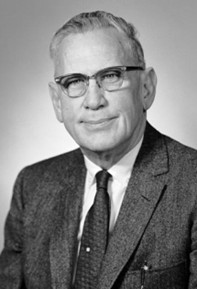
Mr Dick Drew, 60-ish
As a teenager, Drew sought ways to earn money. He took odd jobs and played banjo in a band for dances and local events, supplementing his income through music.
Tragedy: In 1916 Richard’s father, Edward, passed away on September 10 at the age of 55, leaving the family to face both financial and emotional challenges. Drew, with just one year of high school remaining, learned early lessons in persistence and self-reliance.
In 1917, he enrolled at the University of Minnesota to study engineering. After a year and a half, he left without a degree—balancing tuition and school expenses, living expenses, work and study time proved too difficult.
After leaving college, Drew soon enrolled in a correspondence course in machine design, continuing to develop technical skills even while supporting himself with music and odd jobs.
Finally, in 1921, Drew landed a job as a laboratory technician at a small company called Minnesota Mining and Manufacturing, testing their new product, Wetordry.[1] This was the world’s first water-resistant coated abrasive, used by automobile manufacturers to reduce dust and friction that could ruin finishes [2].
Because the company was still small, Drew was often asked to deliver the product to local auto body shops. Two-tone body paint jobs were growing popular in the Roaring Twenties, and at many of the shops he visited, he saw painters struggling to achieve clean, crisp borders between colors. Existing masking methods failed repeatedly, often forcing entire jobs to be redone. He frequently overheard profanity-laced frustration when tapes of the time ruined one paint job after another. One common approach used butcher paper with glues on them; not elegant and often disastrous.
In 1923, in one well-attested account, Drew overheard painters cursing about how existing adhesives and glued paper ruined paint jobs. Motivated, he promised he could come up with a better solution — even though he didn’t yet know how. Until then, he had just stood by and listened. This time he spoke up: “I can produce a tape that will fix your problems.”[3]
It was a brash claim, even outlandish. Who was this sandpaper delivery kid claiming he could solve a problem that frustrated experienced painters and stumped the big adhesive manufacturers?
Drew took the problem back to the company labs. Management was supportive—they were looking for ideas to expand the business—but his primary job remained sandpaper testing. In his spare time, during breaks and evenings, he worked through hundreds of attempts.
He was searching for the impossible: an adhesive strong enough to stay in place during painting but gentle enough to remove without damage.
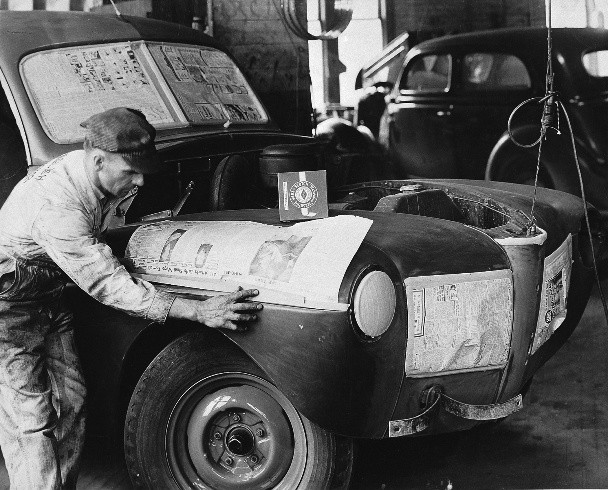
Drew’s invention at work
The tape had to be sticky, but not too sticky. For two years, he experimented with dozens of materials: vegetable oils, various resins, chicle*, linseed, and glue glycerin. Eventually, he developed a product using a good grade of cabinetmaker’s glue combined with glycerines. [* chicle, see author note’s below]
He took it to an auto paint shop for a demonstration. It was a disaster: a beautiful paint job ruined. Humbled yet determined, he returned to the lab. The painters had called him “Scotch”—cheapskate—because he hadn’t applied adhesive across the entire tape. [4] He actually had been trying to be economical, but in doing so, he had created a product that was worse than useless. He himself was the cheapskate, not his management.
By 1925, the tape was a marketable and profitable product. Soon, Scotch® Masking Tape proved indispensable beyond auto shops. It found uses in painting and decorating, arts and crafts, home repairs, office tasks, and industrial applications. Its versatility and reliability quickly made it a staple in households and workplaces alike. As a nod to the auto body painter’s slur, the word “Scotch” was incorporated into the product’s branding.
___________________________________________________________________
But wait! He’s not done yet.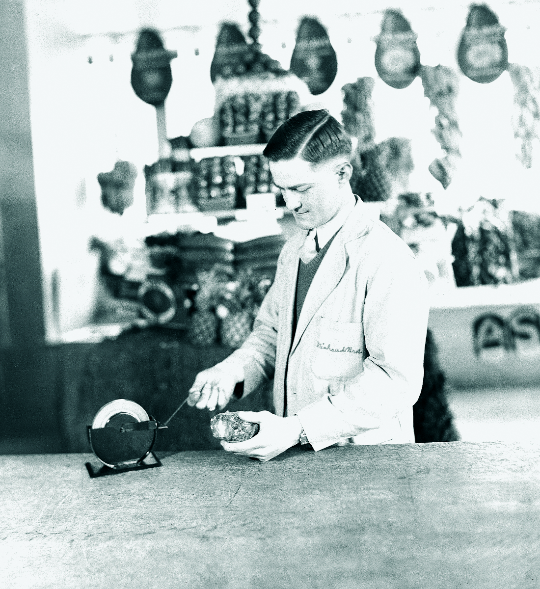
Building on the success of Scotch® Masking Tape, Drew turned his attention to a new challenge: a transparent, general-purpose adhesive tape. In the early 1930s, 3M acquired the rights to cellophane, a clear cellulose film originally developed in Europe. Drew saw the potential to create a tape that could adhere without obscuring the surface beneath — ideal for sealing packages, repairing documents, and a variety of household and industrial uses.
Drew’s experiments led to the first commercially successful cellophane adhesive tape, later branded as Scotch® Cellophane Tape. Unlike masking tape, it was clear, allowed visibility of underlying surfaces, and had broad appeal beyond industrial and automotive contexts. By the mid-1930s, it was sold nationwide, quickly becoming a staple in offices, homes, and schools.
Whereas masking tape had solved a specific industrial problem, cellophane tape was a general-purpose tool, cementing Drew’s reputation as an inventive problem-solver and contributing significantly to the growing popularity of 3M products.
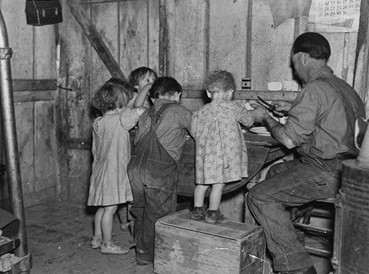
Family repair
During the Great Depression, Scotch® tapes were indispensable for households and businesses striving to make limited resources last. They were used for repairing torn papers, patching broken items, sealing packages, protecting surfaces during painting, labeling boxes, bundling materials, and even mending clothing or household items in a pinch. It was used to repair window shades and even hold broken windows together. Toys, envelopes, sheet music. Their versatility and low cost helped people stretch resources, reduce waste, and keep daily life and business running during economic hardships.
After the success of masking tape and cellophane tape, Drew continued to work at 3M for the rest of his career. He remained there until retiring in 1962, contributing to the development of new pressure‑sensitive adhesive products and helping shape 3M’s innovation culture. In 1943 he established and became director of the company’s Products Fabrication Laboratory, a research group that pursued a range of new technologies and served as a precursor to 3M’s later corporate research centers. Over his career Drew was awarded more than 30 U.S. patents and was known within the company as a mentor who encouraged other engineers to explore creative solutions to practical problems
In 1939, at the age of 41, Drew married Lorna Margaret Cassin, who was 31. She preceded him in death in 1959. There are no records showing that the couple had children. Later he married widow Margaret Wood, in 1959; her first husband was killed in the Korean War, in 1950.
Richard Gurley Drew passed away in 1980, age 81, in Santa Barbara, California, where he had lived since his retirement in 1962. He and Lorna are buried side by side, at Lakewood Cemetery, Section 21, Lot 751, in Minneapolis.
___________________________________________________________________
The painter who screamed an ethnic slur at Drew in 1925 never knew he had named some of the most successful products of the 20th century.
Richard Drew: college dropout, banjo player, sandpaper tester, inventor.
The next time someone calls you cheap or stingy, or not good enough—remember Richard Drew.
Richard Drew heard the same thing. And yet, he changed the world…with sticky tape. His inventions stuck around.
Joe Girard © 2025
Thank you for reading. As always, you can add yourself to the notification list for newly published material by clicking here . Or emailing joe@girardmeister.com
Footnotes.
[1] The name was formally changed to “3M Company ®” in 2002; although they had trademarked that name at its founding in 1902. Over time it simply became known as 3M.
At the time 3M pretty much just made sandpaper. They had just developed a product called “Wetordry” (Read: Wet or Dry), the world’s first water-resistant coated abrasive,
[3] https://www.acs.org/education/whatischemistry/landmarks/scotchtape.htm
[4] Technical reasons for the demo failure. No adhesive in center. The tape could “tent”, float up during operations that already included spray guns that created intense air pressure and vibrations, that could cause the tape to microscopically creep, allowing fine paint mist to sneak underneath, and cause the paint to pull off.
[5] A few uses: House painting and stencil decorating, Arts and Crafts, Home repairs and labeling, Temporary positioning for items like papers, temporary protective coating for sand-blasting, Film and stage production – marking positions, masking surfaces, labeling props, during covid marking the 6 foot (2-meter) spacings on floors, hobby model building.
Author Notes:
- Richard Gurley Drew is in the National Inventors Hall of Fame ® He is also in the Minnesota State Inventors Hall of Fame.
- May 27th is National Cellophane Tape Day.
- A few sources say he also worked for Johnson & Johnson. I believe this is false. Someone made an error and others copied it.
- Chicle: Among the materials he tested was chicle—the natural latex that once formed the base of chewing gum—valued for its elasticity but ultimately too unstable for his purposes. It is the root of the chewing gum product “Chiclet®.” As chicle grew expensive, gums like Chiclet switched to man-made synthesized version of chicle.
Great story!
Amazing how so many things we take for granted had their origins not that long ago.
Agree!
Kind of a ‘sticky’ subject about his later marriages……
Huh? I only found records for ONE later marriage. Not plural. Looks like a beautiful late-in-life marriage to me. A widow and a widower. What could be more natural?
Another great read Joe. Thanks!
“His inventions stuck around” – classic – something I might have said. 🙂