Clair Patterson — The Man Who Dated the Earth and Then Tried to Save It
Lead
It is one of the oldest metals in human civilization — soft, heavy, bluish-gray, and almost absurdly easy to work with. It melts at a temperature a campfire can reach. It resists corrosion. It bends without breaking. It is abundant, cheap, and the ancients loved it.
The Romans called it plumbum — which is why the man who fixes your pipes is a plumber, and why lead’s symbol on the periodic table is Pb. It is heavy — the weighted string a builder uses to find true vertical is still called a plumb bob. They used it everywhere: aqueducts, cookware, wine vessels, roofing, coins, water pipes running beneath entire cities. They even sweetened their wine with it. Lead acetate — “sugar of lead” — is genuinely sweet to the taste, and Roman winemakers boiled their grape must in lead pots to produce a syrup added to virtually everything the affluent table required. The aristocracy was, at every feast, micro-dosing themselves with a neurotoxin. It probably led to the Fall of Rome.
The industrial revolution changed the scale entirely. And then, in 1921, a chemist named Thomas Midgley Jr. working for General Motors discovered that adding tetraethyl lead to gasoline stopped engines from knocking. By the early 1970s, the United States alone was pumping more than 270,000 tons of lead into the air every year. Every breath taken in every American city carried lead in it. Almost no one understood what was happening.
Almost no one.
A metal that seduced every civilization it touched, for eight thousand years, before a farm boy from Iowa finally told the truth about it.
Mitchellville, Iowa. 1922
Clair Cameron Patterson — “Pat” to everyone who knew him — was born June 2, 1922, in Mitchellville, Iowa, a small town of a few hundred souls just east of Des Moines. His father was a postal carrier, a man Pat later described as “a contentious intellectual Scot.” His mother served on the local school board. He had a brother, Paul, and a sister, Patricia.
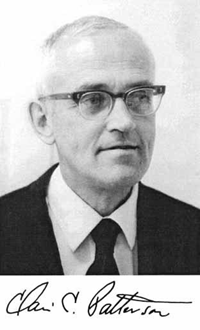
Clair C Patterson, known to all as Pat
There were no cars in Mitchellville when Pat was young. Fewer than a hundred children attended his school. Weekends meant walking four miles to the Skunk River to fish, hunt squirrels, build fires, and camp without adult supervision. It was a Tom Sawyer boyhood.
His mother gave him a chemistry set. He descended to the basement and began mixing things to see what happened. He found his uncle’s chemistry textbook and read it cover to cover. By eighth grade he was correcting his science teachers.
He graduated high school at sixteen, went to Grinnell College — close enough that he hitchhiked home to do his laundry — and graduated in 1943 with a degree in chemistry. At Grinnell he met Lorna McCleary, who went by Laurie, and who would become his wife, his partner, and in the lean years ahead, the family’s primary breadwinner while Pat chased bigger questions.
He earned his master’s degree in molecular spectroscopy from the University of Iowa in nine months. The Army draft board took note and made a decision: this one was more valuable in a laboratory than a foxhole.
They sent him to Oak Ridge, Tennessee.
Oak Ridge, Tennessee. 1944
Oak Ridge lies in a valley between the Cumberland and Great Smoky mountains, about twenty miles west of Knoxville. It is a beautiful setting — forested ridges, clean rivers, the kind of East Tennessee landscape that feels ancient and unhurried. In 1942, the Army Corps of Engineers arrived, bought 60,000 acres of farmland at roughly $47 an acre, evicted the families who lived there, and built a city of 75,000 people that did not appear on any map. They called it the Secret City. Most residents had no idea what they were actually building.
Pat Patterson knew. His job at the Y-12 plant was uranium isotope separation — specifically, the problem that made the atomic bomb both possible and extraordinarily difficult. Uranium comes in two forms. Uranium-238 is the common variety, comprising more than 99 percent of all uranium on earth. Uranium-235 is the rare one — chemically identical, differing only in the number of neutrons in its nucleus — and it is the one that splits violently enough to level a city. The mass spectrometer sorted them. Feed uranium atoms into a magnetic field and the heavier ones curve differently than the lighter ones — the machine reads the difference the way a river sorts sand from gravel. Patterson worked those instruments in the Tennessee valley, separating the useful from the useless.
Here is the detail worth pausing on. U-238 does decay — slowly, steadily, emitting particles on its way to becoming something else entirely. It is just extraordinarily patient about it, with a half-life of 4.5 billion years. That patience makes it useless for a bomb. It also makes it a perfect geological clock. The same physics that rendered U-238 irrelevant to the Manhattan Project would later hand Patterson the key to one of science’s oldest questions.
He didn’t know that yet. He was still in Tennessee, separating isotopes, contributing his small piece to what would become the bomb dropped on Hiroshima.
He was horrified when it fell.
After the war, he returned to Chicago to finish his doctorate — no longer separating isotopes to end lives, but to find the age of the earth. The mass spectrometer remained his instrument. The element he would measure remained lead. But the question had changed entirely.
Chicago. 1946
His mentor at the University of Chicago was Harrison Brown, a geochemist with a compelling idea and a gift for understatement. Brown believed he had found a way to determine the age of the earth — by measuring the ratio of uranium to lead in ancient rocks. Uranium decays into lead at a known, fixed rate. Measure how much uranium remains and how much lead has accumulated, and you can calculate how long the process has been running. Simple in concept. Staggeringly difficult in practice.
Brown handed the project to Patterson and a colleague, George Tilton. The key was zircon — a mineral with a remarkable property. When zircon crystals form, they incorporate uranium but reject lead entirely. None. So any lead found in a zircon sample must have arrived there one way: through the radioactive decay of uranium, over geological time. The lead was the clock. Patterson’s job was to read it.
“Duck soup,” Brown told him.
It took seven years.
The problem was contamination. Patterson was trying to measure lead at almost unimaginably small concentrations — and lead was everywhere. In the air. In the dust. In the glassware. In the water. In the reagents. In the old Kent Hall laboratory building itself, with its decades of accumulated grime. Every time he prepared a sample, background lead swamped his measurements. His data was useless. He couldn’t find the earth’s age because he couldn’t find the earth’s lead — it was buried under the noise of everyone else’s.
He found something else instead.
The lead contaminating his samples wasn’t geological. It was industrial. It was everywhere in the modern world in quantities that had no natural explanation. He filed that observation away and kept working. There was still an age to find.
Pasadena, California. 1952
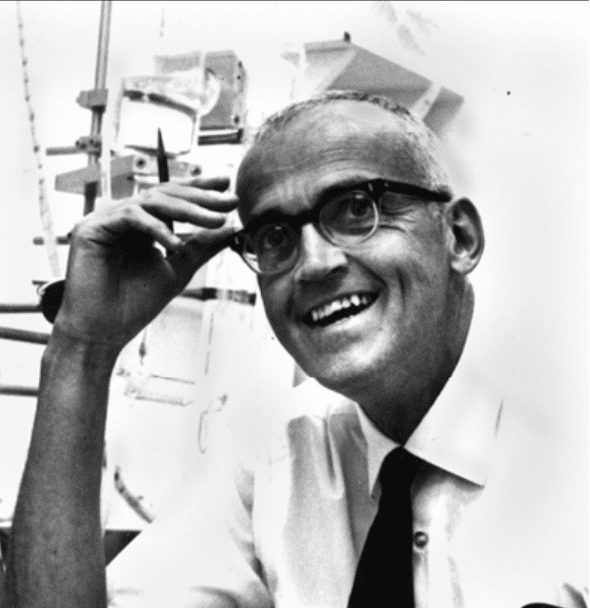
Patterson, in his Cal Tech lab, 1960s
Brown moved to Caltech and brought Patterson with him. Pat built his laboratory from scratch — and this time he built it differently. He sealed every point of entry against outside air. He acid-washed every piece of equipment. He distilled his own chemicals rather than trust commercial supplies. He was creating, essentially by necessity, one of the first scientific clean rooms ever built — not for safety, but for silence. He needed a laboratory quiet enough to hear a whisper of ancient lead above the roar of modern contamination.
The Canyon Diablo meteorite had fallen to earth 50,000 years ago near what is now Meteor Crater, Arizona. It was, in geological terms, pristine — a fragment of the original solar system, largely unchanged since the planets formed. Patterson obtained samples, prepared them in his clean room, and ran them through the mass spectrometer. The lead isotopes told their story. The uranium had been decaying for a very long time indeed.
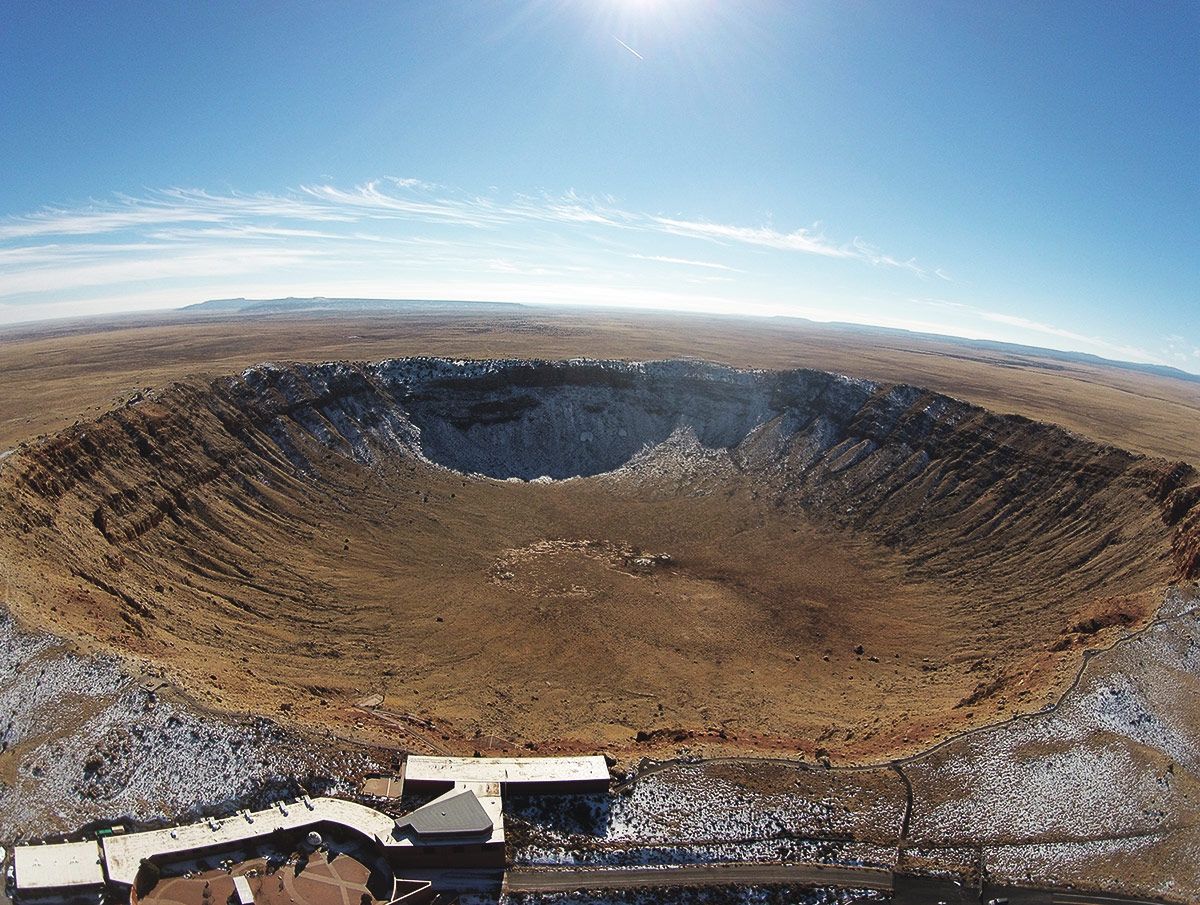
Meteor Crater, Arizona — where the Canyon Diablo meteorite struck 50,000 years ago
In 1956, he published his answer: the earth was 4.55 billion years old, give or take 70 million years. [1]
The previous best estimate had been around 3.3 billion. Patterson hadn’t just refined the number — he had redrawn the timeline of existence. His figure has not meaningfully changed in nearly seventy years.
He could have stopped there. Any scientist alive would have been satisfied. But the contamination problem that had plagued him for years wouldn’t leave him alone. His clean room had given him the answer he needed — and in doing so had shown him something else entirely. The difference between the lead levels inside his sealed laboratory and the lead levels in the world outside was not subtle. The outside world was saturated. Not geologically. Industrially.
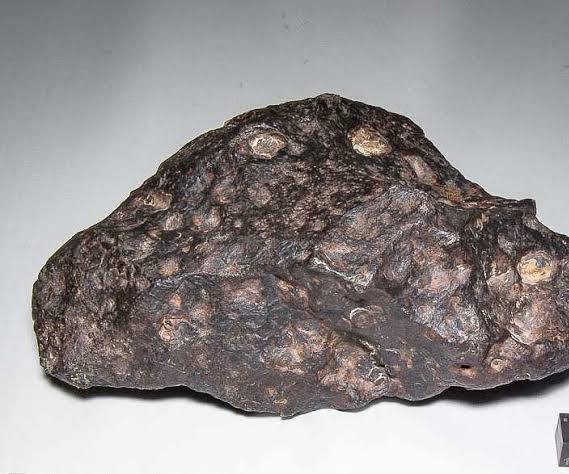
Fragment of the Canyon Diablo meteorite — the ancient rock that told us how old we are
The farm boy from Iowa had stumbled onto the second great question of his career — and this one had an enemy attached to it.
The Knock
An internal combustion engine works by compressing a fuel-air mixture and igniting it at precisely the right moment. When the mixture ignites too early — before the spark plug fires — the result is a sharp metallic rapping from inside the engine. Drivers called it knocking, or pinging. It robbed engines of power, damaged cylinders, and unnerved customers. By the early 1920s it was the automobile industry’s most pressing engineering problem.
A General Motors chemist named Thomas Midgley Jr. tried hundreds of substances looking for a solution — melted butter, camphor, iodine, aniline. On December 9, 1921, he added a few drops of tetraethyl lead to a test engine’s fuel. The knock vanished. Midgley and his colleagues, it is said, danced “a very unscientific jig” in celebration.

Flying A Ethyl Gasoline pump, circa 1950s. The “Ethyl” brand name — chosen to obscure its lead content — appeared on pumps across dozens of gasoline brands for fifty years
The fix worked by raising what we now call the octane rating — the temperature at which the fuel ignites, giving the piston time to complete its stroke before combustion occurs. A tiny amount of lead, one part per 1,300 of gasoline, was all it took. It was cheap, it was effective, and General Motors, Standard Oil, and DuPont moved quickly to commercialize it through a joint venture they called, with deliberate blandness, the Ethyl Gasoline Corporation.
There was an alternative. Ethanol raised octane just as effectively. But ethanol couldn’t be patented, and anyone could make it. Tetraethyl lead could be controlled and patented. The choice was commercial, not scientific — and it was made knowing full well that lead was poisonous. A DuPont executive described TEL in 1922 as “a colorless liquid of sweetish odor, very poisonous if absorbed through the skin.” When workers at the Bayway, New Jersey plant began hallucinating and dying of acute lead poisoning in 1924, Midgley held a press conference. He poured TEL over his hands, held a bottle under his nose, and inhaled it for sixty seconds. He declared he could do this every day without harm. [2]
The first tank of leaded gasoline had gone on sale the previous year. It would be over fifty more years before the last one did.
* * *
Lead is a remarkably effective impostor. In the body, it mimics calcium—similar electronic charge [3], similar size—and the body’s transport systems cannot reliably tell them apart. Lead rides those systems straight into bones, teeth, and across the blood-brain barrier into the brain itself. Once lodged in bone it can stay for decades, slowly leaching back into the bloodstream throughout a lifetime. It interferes with the formation of red blood cells, reducing their ability to carry oxygen. In the brain it disrupts the neural processes that govern learning, memory, and impulse control. In children, whose developing nervous systems absorb it faster and more completely than adults, even low levels cause measurable reductions in IQ and lasting behavioral damage. There is no safe level. There never was.
All of this was being pumped into the air of every American city, every day, by every car on the road.
Patterson knew. The question was whether anyone would listen.
* * *
The Find
Patterson hadn’t set out to save anyone. He was still trying to understand lead — specifically, whether the contamination swamping his clean room samples was geological or something else entirely. In 1963 he published a paper in Nature laying out what he had found in ocean water and polar ice: the lead levels in the modern environment were not natural. They were industrial. And they were enormous — as much as a hundred times higher than pre-industrial levels. The source was unmistakable. Every automobile on earth was exhaling it.
Four days after the paper appeared, four men in suits arrived at his Caltech office. They represented the oil and chemical industries. They offered funding if he redirected his research.
He declined. His existing industry grants were not renewed. The U.S. Public Health Service cut off his funding. Someone called the Caltech president to have “that nut” dismissed. His colleagues protected him.
The industry’s designated defender was a physician named Robert Kehoe, who had spent forty years as chief medical advisor to the Ethyl Corporation — paid entirely by the industry he was evaluating. Kehoe’s position was simple: lead levels in modern humans were normal, therefore natural, therefore harmless. Patterson’s response was equally simple. Normal and natural are not the same word. The lead in human bones had increased 700-fold since pre-industrial times. That was not nature. That was us.
The fight lasted twenty years. Patterson testified before Congress. He published. He went to Antarctica and found lead in ice cores from before the birth of Christ — and vastly more in cores from after 1923, the year leaded gasoline went on sale. The data were unambiguous.
In 1970 the Clean Air Act gave the newly formed EPA authority to regulate fuel additives. In 1973 the phase-out began. By 1986 leaded gasoline was effectively gone from American pumps. Blood lead levels in children dropped by eighty percent within a decade.
* * *
Anyone born before leaded gasoline disappeared from American pumps in the mid-1980s carries lead in their bones today. Not as a trace. As a legacy. It arrived on every breath of city air, displacing calcium in bone, taking up residence where it was never meant to be. It is still there. Blood lead levels across the American population have dropped 94 percent since the phase-out began — but the lead in our bones does not leave on the same schedule as the lead in blood. It has no schedule at all. It stays. Even past death.
Pat Patterson, farm boy from Mitchellville, Iowa, gave us the age of the earth and then spent decades fighting to keep it livable. He died in Sea Ranch, California on December 5, 1995, at the age of 73 — largely unknown outside his field, having accomplished more for human health than almost any physician who ever lived.
Clair “Pat” Patterson. He deserves to be remembered.
Joe Girard © 2026
Thank you for reading. You can add yourself to the notification list for newly published material by clicking here, or emailing joe@girardmeister.com
Footnotes
[1] Patterson’s 1956 figure of 4.55 billion years has held up remarkably well. The current accepted age of the earth is 4.54 billion years, with an uncertainty of less than one percent — a refinement, not a revision. The adjustment came primarily from more precise measurements of radioactive decay constants. The figure has been cross-checked by multiple independent radiometric methods beyond uranium-lead dating: potassium-argon dating of ancient terrestrial rocks, rubidium-strontium dating of igneous and metamorphic formations, samarium-neodymium dating of meteorites, and analysis of lunar samples returned by the Apollo missions. All converge on the same answer, from different elements, different decay chains, and different source materials. Patterson got it right the first time.
[2] Thomas Midgley Jr. is one of history’s more consequential cautionary tales. Beyond tetraethyl lead, he also invented Freon — the chlorofluorocarbon refrigerant that would later be found to be destroying the ozone layer. One historian remarked that Midgley “had more impact on the atmosphere than any other single organism in Earth’s history.” He contracted polio in 1940 and was left severely disabled. Ever the engineer, he designed an elaborate system of ropes and pulleys to lift himself out of bed. In 1944, he was found dead, strangled by his own device. The coroner ruled it a suicide, though some accounts suggest it may have been accidental. He was 55. The leaded gasoline he championed would continue poisoning the atmosphere for another half century.
[3] Lead is actually in the +/-4 column in the periodic table. For reasons that escape my comprehension, in many of these elements prefer to be +2, like Calcium
Author’s Notes
- Lead is classified as a neurotoxin not because it goes directly to the brain in large quantities, but because of its calcium mimicry. Once in the bloodstream it exploits calcium transport systems, and calcium is the key that unlocks the blood-brain barrier. Lead rides those same transport channels across — in small but devastating amounts. Once inside the brain it disrupts the neural signaling that depends on calcium, interferes with the enzymes that build and maintain neural connections, and damages the prefrontal cortex and hippocampus — the regions governing impulse control, learning, and memory.
- Bill Bryson, in A Short History of Nearly Everything, describes Patterson recruiting volunteers to ingest lead and, finding none in their feces and observing no immediate ill effects, briefly concluding it was safe — not yet understanding that the lead wasn’t passing through. It was staying.
- This essay was researched with the assistance of Claude, an AI developed by Anthropic. Claude was also used for editing. The historical judgment, selection of facts, structure, voice, and final text are completely the author’s. A final review was provided by Gemini, the Google AI tool.