A young woman—twenty-two, penniless, and shabbily attired—is admitted to the Women’s Lunatic Asylum on New York’s Blackwell’s Island. Nothing in that moment hinted at what was about to unfold—or ignite. 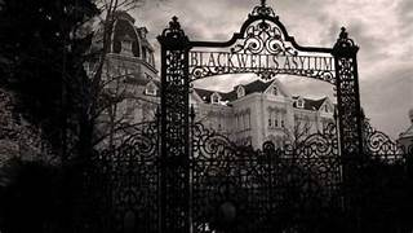
___________________________________________________________
Michael Cochran was born in 1810 in the wild forests of hilly Westmoreland County, just east of Pittsburgh, Pennsylvania. Although his early life remains somewhat obscure, sources suggest he began as a laborer and mill worker. In 1830, he married a local girl, Catherine Murphy. They had ten children before Catherine passed away in 1857.
By 1849, Michael had acquired enough capital and know-how to purchase a mill a few miles north in Armstrong County, along Crooked Creek near its confluence with Cherry Run. The mill proved profitable, and he began to build a village around it, which he named “Cochran’s Mills.” The settlement soon had its own post office and general store—founded by Michael himself. Over time, he was made a local judge and acquired additional land holdings in the area.
Michael then met Mary Jane Kennedy, also recently widowed, and they married in 1859. Mary Jane bore him five more children, all born in Cochran’s Mills. Of his fifteen offspring, thirteen were daughters. Elizabeth, the 12th, arrived on May 5, 1864. One can imagine that life was rather spartan for all of them, despite Michael’s standing in the community.
Michael Cochran passed away in 1870, when Elizabeth was six years old. He died intestate, which carried severe financial consequences for his family.
Because Michael Cochran died intestate, his widow, Mary Jane, was entitled under Pennsylvania probate law to a dower—roughly one-third of the estate for her lifetime. The remaining assets, including the mill, store, and land, were distributed among the children or placed in a trust. While the dower provided some support—probably paid like an annuity at around $400 per year—֫ it was insufficient to maintain the family’s former standard of living, and the trust intended for the younger children was reportedly mismanaged. As a result, Mary Jane and her children were left in financially precarious circumstances, a reality that would shape Elizabeth’s determination.
There was nothing left in Cochran’s Mills for Mary Jane and her children. She moved the family to Pittsburgh, hoping to get enough work to keep the family solvent. It was a long fall from the more comfortable and socially lofty life along Crooked Creek.
By age fifteen, Elizabeth had completed as much education as was available to a girl from a working-class family attending the Common Schools. She went off, some fifty miles to the east and north, to attend Indiana Normal School in Indiana, Pennsylvania, in the rising foothills of the Allegheny Mountains. Normal schools, scattered across the country, were designed to prepare promising young women for work in elementary education—one of the few respectable professions available to women at the time.
Elizabeth’s education at the Indiana Normal School was cut very short; the family lacked the funds to complete even a single school year. She hadn’t even lasted one term. She left with little additional education and no accreditations. She returned to Pittsburgh to find work. But in her heart, she wanted to be a writer; despite having little more than a grade-school education.
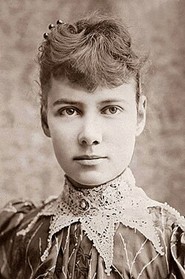 One day in January 1885, Elizabeth was reading the Pittsburgh Dispatch when she came across a column titled “What Can Girls Do?” The author argued that women were fit for little beyond the home and unfit for most jobs or professions. Enraged, Elizabeth wrote a blistering but articulate rebuttal, combining passion with logic and moral reasoning. She signed it “Lonely Orphan Girl.” It was published in the Dispatch. She was a writer!
The Dispatch’s chief editor, George Madden, was so impressed that he publicly called for the anonymous author, this Lonely Orphan Girl, to come forward. Elizabeth did. She was hired on the spot, beginning a career that would make her name known across the country.
__________________________________________
Elizabeth spent roughly two years at the Dispatch, penning columns, many of which blended human-interest stories with social commentary. She covered the plight of working women and children, urban poverty, and the struggles of the poor, displaying a talent for observation and reasoned argument. Her work combined storytelling with advocacy, bringing attention to social conditions that most readers ignored. She conducted on-the-ground investigations, visiting factories, schools, and neighborhoods of shabby row-houses. Though still early in her career, these columns established her as a journalist willing to tackle real-world issues, laying the foundation for the investigative reporting that would later make her famous.
It was while working here, at the Pittsburgh Dispatch, that Elizabeth formally changed her surname to “Cochrane”, adding an “e” at the end. And, encouraged by the paper’s editor, Madden, she took the nom de plume of “Nellie Bly” (taken from a popular song of the day, chosen for its friendly, memorable, and slightly androgynous quality).
Perceiving Pittsburgh as too small a setting, with limited opportunity for the career she imagined, she left her job and set out for New York — armed only with a collection of her columns and letters, with no certifications, no connections, no high school diploma, and no accolades.
Upon arriving at the New York World, Elizabeth presented her portfolio to the editors and impressed them with her writing, insight, and determination. Joseph Pulitzer himself recognized her talent and quickly offered her a position. At last, she had a platform far larger than Pittsburgh — a citywide, even nationwide—stage on which to pursue the investigative journalism she had long envisioned.
At Pulitzer’s New York World, Elizabeth expanded her reporting beyond Pittsburgh, covering the daily struggles of New Yorkers living in poverty. She wrote about working women enduring long hours in factories, children forced into labor, and street urchins: orphans and abandoned children, whose numbers and conditions still contributed to driving the Orphan Train movement. Her assignments often took her into tenements, crowded schools, and poor neighborhoods, allowing her to document conditions that most citizens never saw. This work helped her build a reputation for attentiveness, compassion, and a willingness to confront the social problems of the city head-on.
It was the days of sensationalism in Newspapers. Yellow Journalism. It sold papers. Boosted circulation. Sales and circulation meant more ads, more money, the lifeblood of any profitable business, or one that intended to be profitable.
As such, Cochrane (AKA Nellie Bly, she was going exclusively by “Nellie Bly” now) approached the World’s leaders with a plan. It was approved. Pulitzer, when he became aware, supported it whole heartedly as well.
Nellie took lodging at the Temporary Home for Females, a refuge for women in duress, under the name Nellie Brown, at 84 Second Avenue. She deliberately behaved oddly, with increasing agitation, refusing to sleep, insisting other boarders were dangerous, and repeatedly claiming to be robbed. This behavior alarmed (terrified!) the house matron, who contacted the police after just a few days of her residence.
She was taken to Bellevue hospital for evaluation. She kept up the charade, now perfected. From there she was sent to the Women’s Lunatic Asylum on Blackwell’s Island.
During her time at the asylum, Bly observed appalling conditions that shocked her. Patients were crowded into unsanitary cells, poorly clothed, and given inadequate food; many were physically restrained with straitjackets, manacles, or heavy chains. Staff treated the “patients” with cruelty and indifference, administering harsh punishments for minor infractions. The facility was understaffed and disorganized, with little medical oversight, and many inmates appeared to be there simply because they were poor, elderly, or socially inconvenient— rather than genuinely mentally ill. Bly documented these abuses, describing both the physical environment and the mistreatment she witnessed, producing a damning exposé that revealed systemic neglect and galvanized public demand for reform.
After ten days the paper, with Pulitzer’s power and gravitas, got her release.
The New York World ran a series of articles by “Nellie Bly” in November, 1887. The reaction was electric. The city was horrified by the reckless abuse. The New York State legislature responded immediately. Investigators were sent to Blackwell’s Island. Bly’s reports were confirmed. Grand Juries were convened.
It was what Pulitzer and his editors wanted: uncovering corruption and government incompetence. Sensationalism. Nellie Bly—Elizabeth Cochrane—was a journalistic star.
Changes soon followed. More and better trained staff. Improved sanitation and living conditions, less crowding. Stricter intake procedures to prevent wrongful commitments—wheth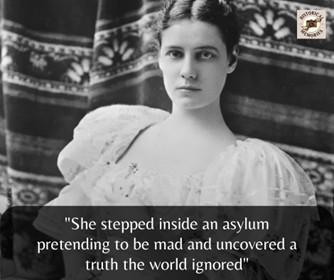 er by family or foe.
When the papers sold out, Bly was implored to republish the series. She did, as a book, called Ten Days in a Mad-House, published by Norman Munro. It extended the sensation among the public. It quickly sold out its first run. It became one of the most famous works of investigative journalism of its era. And it is still in print and available. It’s still referenced today as well.
The immediate aftermath of her exposé elevated Nellie Bly to national fame. She continued writing for the World, leveraging her notoriety to pursue other investigative assignments and human-interest stories. She traveled extensively, reporting from locations and situations few women of the era could access, including prisons, factories, and hospitals.
In 1888, she embarked on her most famous adventure: an attempt to travel around the world in fewer than 80 days, inspired by Jules Verne’s novel. She completed the journey in 72 days, gaining international acclaim and cementing her reputation for daring, meticulous reporting. The experiences were published in a book, Around the World in Seventy-Two Days (often called simply, 72 Days). It was also successful, well-received, and widely read.
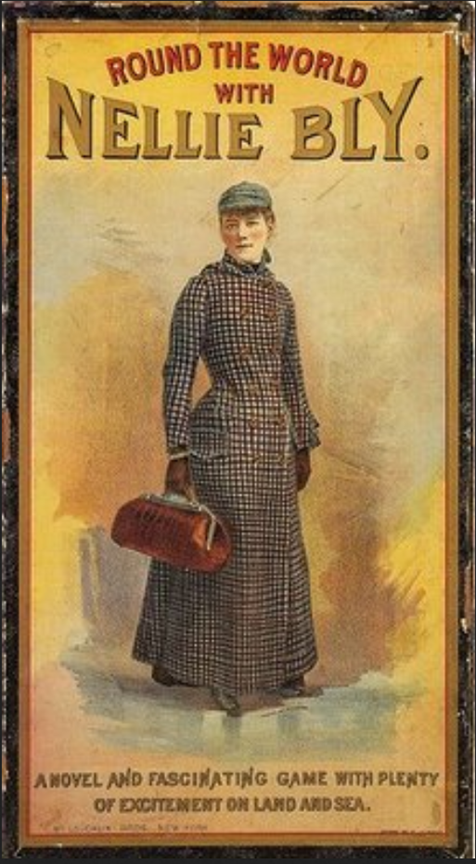
Book Cover
Bly also continued her work in social reform. She reported on poverty, child labor, and conditions for working women, often combining immersive investigation with advocacy for legislative or institutional changes. Her career blended journalism, travel writing, and social activism, setting a template for investigative reporters and undercover journalists alike that stretched to today.
She eventually added business ventures to her endeavors, including investments in manufacturing and newspapers. Her career spanned decades, but the ten-day asylum exposé remained the defining achievement that launched her into public consciousness.
In 1895 she married widower Robert Seaman, thirty years her senior, a wealthy industrialist who owned the Iron Clad Manufacturing Company in Brooklyn. They never had any children. After his death, in 1904, Nellie took over the company.
By the 1920s Nellie was in declining health, suffering a series of lung infections. She knew the end was near, and closed out all of her financial issues from a hospital bed, including selling the company in January, 1922. She passed away just days later, January 27th. . Cause of death was listed as pneumonia, complicated by heart disease. Age 57 years.
Nellie Bly did not enter the lunatic asylum for fame. She stepped into darkness so others could be seen. She risked her own safety to give a voice to those the world had forgotten, and in doing so, she helped shape the future of journalism. With only an elementary school education, grit, determination and self-confidence.
Joe Girard © 2025
Thank you for reading. As always, you can add yourself to the notification list for newly published material by clicking here . Or emailing joe@girardmeister.com
Notes:
In 1998, Bly was inducted into the National Women’s Hall of Fame.
https://www.britannica.com/biography/Nellie-Bly