Cathay Williams — Soldier, Ghost, American
Trinidad, Colorado. June, 1891
She had been in the hospital for the better part of two years. The diabetes had taken her toes — not all at once, but one at a time, the way that disease does its work, slowly and without mercy. The neuralgia was constant. Her right ear had gone deaf. The arthritis was brutal. Shrunken lung capacity. She moved on crutches now, when she moved at all.
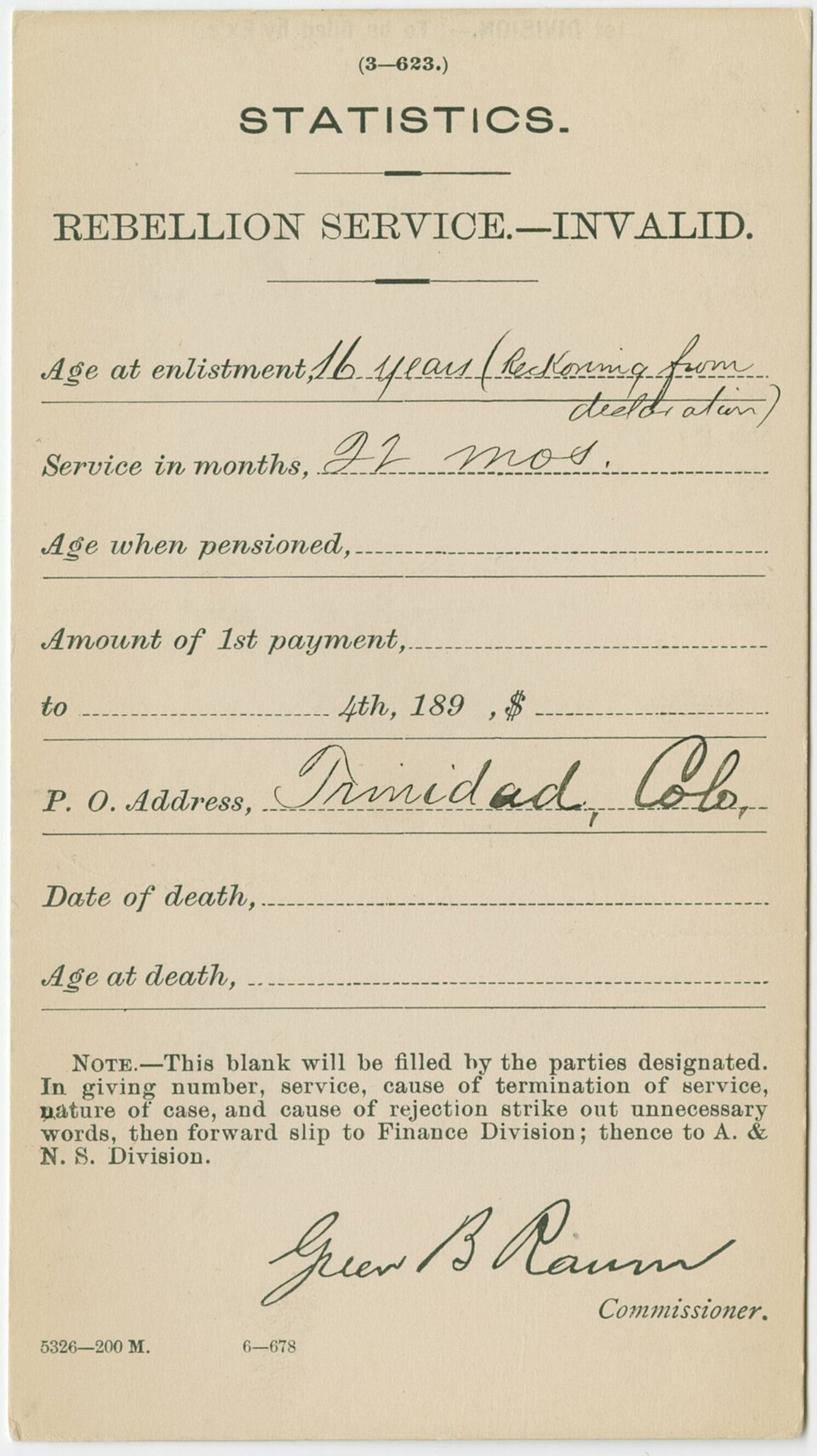
In June of 1891, Cathay Williams made her way to the office of the Las Animas County clerk and swore out a declaration. She was, she stated under oath, one and the same person as Private William Cathay, formerly of Company A, 38th United States Infantry. She had served her country for two years on the frontier. The service had broken her body. She could no longer support herself by the labor of her hands.
She was applying for the pension she had earned.
Then she went home and waited.
Independence, Missouri. September, 1844
Independence, Missouri, sat on the left bank of the Missouri River, at the very western edge of the United States. Founded in 1827 — seven years after the compromise that permitted slavery in Missouri — as the farthest upriver port the steamboats could reliably reach, it had grown from a fur trading outpost into a prosperous, restless town of outfitters, merchants, and dreamers.
Across the river, a ferry ride away, lay unorganized Indian Territory — legally off-limits to white settlement, stretching west into distances no American had fully mapped. From here the Oregon Trail cut ruts northwest along the Missouri toward the Pacific, and the Santa Fe Trail pressed southwest toward New Mexico and the silver trade.
It was into this city that Cathay Williams was born, to a free man [1] and an enslaved woman. Under Missouri law — under American law — the child followed the mother. Her father’s freedom meant nothing to her legal standing. She was property from her first breath.
The law held people in chains.
The Johnson family were slave holders. Their plantation sat just outside Jefferson City, the state capital, some 130 miles to the east — close enough to the seat of Missouri’s government that the ironies were not subtle. Cathay was brought there as a child and worked as a house slave — cooking, cleaning, tending to the Johnson family’s domestic needs. There is no record of what she thought, what she dreamed, or what she endured. Enslaved people were not given the luxury of a written record. We know her name, her approximate birthdate, and where she was held.
We know what came next.
Jefferson City, Missouri. 1861
The Civil War arrived in Missouri early and ugly. The state was bitterly divided — a slave state that never seceded, a place where neighbors shot neighbors and the war was intimate and vicious. In the spring of 1861, Union forces occupied Jefferson City in the war’s opening weeks, sweeping through the state’s capital city with enough urgency that there was little time to sort out the complexities of who was enslaved and who was not.
The Army needed labor. Cathay Williams — seventeen years old, strong, capable — was swept up in that tide. The military classified her, along with other enslaved people taken from Confederate-sympathizing households, as “contraband.” This was the Union’s sanitized legal solution to a problem it hadn’t yet fully reckoned with: you couldn’t simply free enslaved people in a state that hadn’t seceded, but you also couldn’t send them back. So they became property of war. Contraband. Belonging to neither side and to no one.
It was a strange and bitter kind of liberation.
For the next four years, Cathay traveled with Union forces across the full theater of the war. She cooked. She cleaned. She washed. She served the officers of several different regiments — among them the staff of General Philip Sheridan during his legendary Shenandoah Valley campaigns. She marched through Arkansas, Louisiana, Georgia. She was present at the convulsions of the greatest war the young country had ever seen.
She did not march as a soldier.
She was not paid as a soldier.
She was not recognized as anything at all.
The Army moved through her life, and she moved through the Army, and when the guns finally fell silent in the spring of 1865, the United States had freed four million enslaved people and had no particular plan for what to do next.
Cathay Williams was 21 years old, free at last, and on her own.
St. Louis, Missouri. November, 1866
The question that faced every freed Black woman at the end of the Civil War was the same question, asked a thousand different ways: Now what?
The options were brutally narrow. Domestic service. Laundry. Field labor. The same work, for the same people, now technically for wages — wages that were often withheld, docked, or simply never paid. The old order had changed its name. The new one felt remarkably familiar.
For Cathay, there was one institution she knew. One “employer” she had traveled with, marched with, watched up close for four years. The United States Army was hiring. In July 1866, Congress had authorized the creation of six new regiments of Black soldiers — the Buffalo Soldiers, as they would come to be known — to police the frontier, guard the railroads, and push into the vast territories of the American West.
There was just one problem.
Women were not allowed to enlist.
Cathay Williams stood five feet, nine inches tall — well above average for both men and women of that era. She was broad-shouldered and physically powerful, built by years of walking and hard labor. She looked, in the eyes of at least one Army recruiter, like a man.
She reversed her name.
William Cathay
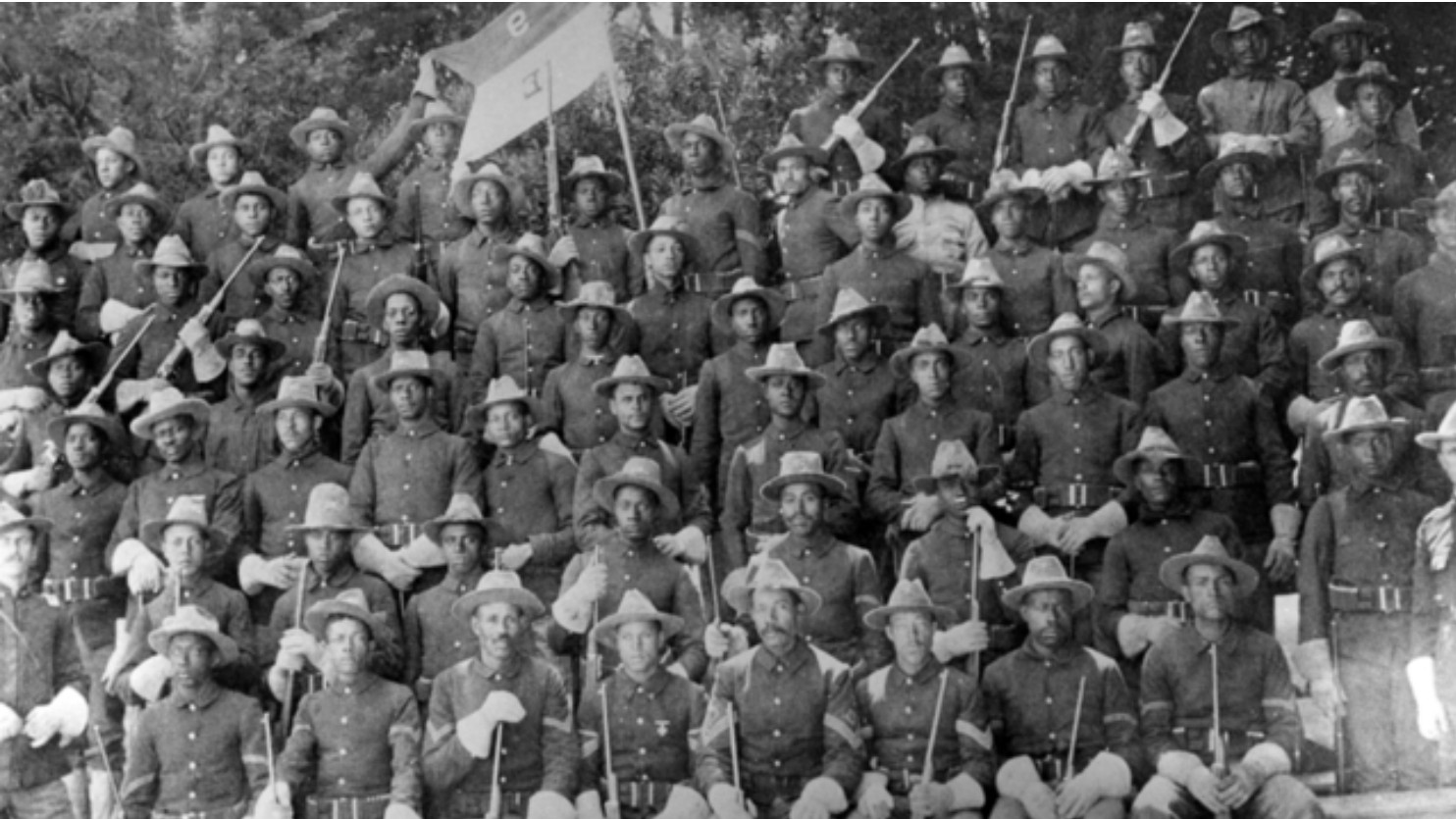
Buffalo Soldiers
On November 15, 1866, at Jefferson Barracks in St. Louis, she submitted to the Army’s cursory medical examination. The doctors were overworked and under-resourced; a thorough physical was a luxury the recruiting office could not reliably provide. The exam passed quickly. William Cathay was pronounced fit for service and assigned to Company A of the 38th United States Infantry.
Two people in the regiment knew her secret — a cousin and a close friend, both serving in the same unit. Both kept their word. [2]
Private William Cathay shouldered a rifle and marched west.
Trinidad, Colorado. February 8, 1892
Eight months is a long time to wait when your toes are gone and the rent is due and all of your joints ache with the pain of thousands of miles of marching through dust.
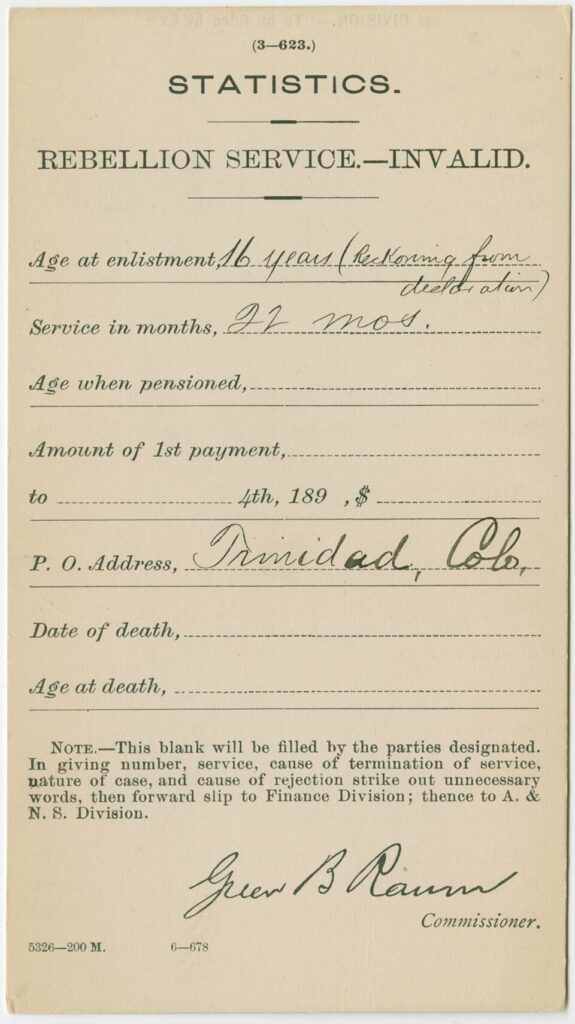
The letter from the Army arrived in the dead of winter. The pension claim of one Cathay Williams, formerly William Cathay, had been reviewed. The finding: no pensionable disability. The claim was denied.
No one had examined her. No doctor had been sent. A clerk somewhere had looked at the paperwork, made a determination, and moved on to the next file.
She had fought her way across a thousand miles of frontier. She had outwitted an Army recruiting office, two years of bunkmates, and five separate hospitalizations. She was not, by any reasonable measure, a woman who accepted a form letter as a final answer.
She appealed. [3]
And waited again.
The Frontier, 1867–1868
The 38th Infantry moved hard and fast across the American Southwest. Fort Riley, Kansas, then Fort Harker — where a cholera outbreak was already sweeping through the regiment, killing men who had survived the Civil War. The regiment’s march continued regardless: more than 500 miles south and west, down the Santa Fe Trail to Fort Union in New Mexico Territory, arriving July 20, 1867. Then 350 miles more across the New Mexico desert to Fort Cummings. Then Fort Bayard.
One historian estimates that Cathay Williams walked a thousand miles in her two years of service. [4] She walked them in the summer heat of the Kansas plains and the high desert of New Mexico, through cholera outbreaks, through Apache territory, through country that had no patience for the weak or the unlucky.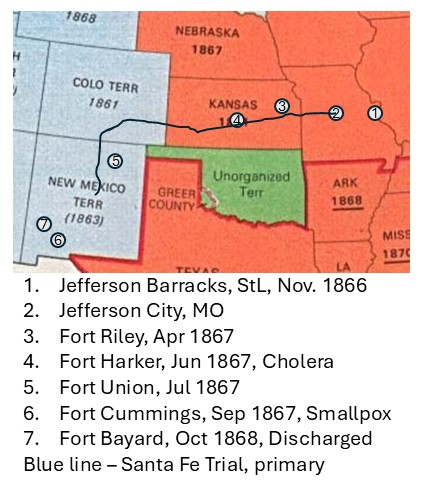
Smallpox found her early. In her own words, she contracted the disease shortly after enlistment, while still in St. Louis, and was hospitalized. She recovered and went with her unit at Fort Riley. But smallpox is not a disease that simply passes and leaves no trace. The virus attacks the bones and the joints — the elbows, the knees, the extremities — leaving behind arthritis, chronic swelling, and in many cases, permanent deformity. It damages the lungs, irreversibly. A smallpox survivor marching through summer desert heat at altitude is marching on borrowed time, with borrowed air. The debt can only accumulate.
Cathay kept up anyway. She drilled. She stood watch. She performed garrison duties. She moved through it all as William Cathay — a quiet, capable private, unremarkable enough to avoid scrutiny, tough enough to do the work. She was hospitalized four more times over the next two years, in four different hospitals, for rheumatism, neuralgia, and what the Army’s records called “general debility.” Not once, through any of those hospitalizations, did anyone discover she was a woman. What that says about the quality of medical care provided to Black soldiers in the frontier Army is its own kind of indictment. Yet, she never complained.
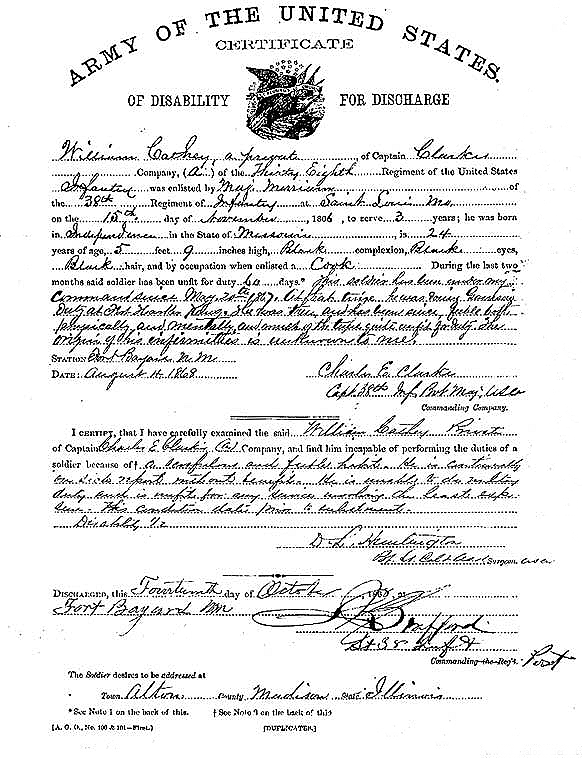
By the autumn of 1868, she was done. The joints. The lungs. The heat. The accumulated weight of two years of frontier soldiering on a body that smallpox had already compromised. She checked into the post hospital at Fort Bayard one last time — and this time, she later admitted, she helped things along.
“I got tired and wanted to get off. I played sick, complained of pains in my side and rheumatism in my knees.”
Consider what that confession contains. She had genuine smallpox damage in her joints and lungs. She had genuine neuralgia running through her nerves. She had two years of desert marching in her legs and compromised lungs in her chest. And she — a woman who had endured all of that in silence — felt she still needed to exaggerate to be believed.
The post surgeon at Fort Bayard conducted a more thorough examination than any that had come before. He found out. He informed Captain Charles E. Clarke, her commanding officer. And Captain Clarke — to his credit — did not court-martial her, did not punish her, did not make a scene. On October 14, 1868, he granted Private William Cathay an honorable discharge on a certificate of disability.
She walked off the post at Fort Bayard on crutches.
She was 24 years old.
Eight years later, speaking to a reporter in Trinidad, she let something out that she had apparently been carrying since that October day on the post:
“The men all wanted to get rid of me after they found out I was a woman. Some of them acted real bad to me.”
It was not a factual account of her discovery — it was the surgeon who found out, and the captain who let her go quietly and with dignity. It was something else. Old anger, finally finding air.
Trinidad, Colorado. September, 1892
He arrived without ceremony — a government doctor, appointed by the U.S. Pension Bureau, dispatched to Trinidad to settle the matter of one Cathay Williams once and for all.
She received him on crutches. There was nothing else to stand on.
He examined her. He saw the amputated toes. The deaf ear. The neuralgia that had been running through her nerves since the frontier. The rheumatism in the knees she had once ‘played up’ at Fort Bayard — and which smallpox had in fact been quietly destroying for more than twenty years. He noted a body that had marched a thousand miles on the damage of one disease and then spent two decades accumulating the rest. He asked his questions. He completed his form.
The Pension Bureau had also written to her private doctors in Trinidad. Those men did not, or could not, provide the bureau with any useful information. She had no one in her corner. Two former comrades — Corporal James Richards and Private James Webster, both of Company A — had submitted affidavits on her behalf, confirming her service and attesting to her disabilities. It was not enough.
The doctor forwarded his findings to Washington.
She waited one last time.
New Mexico and Colorado. 1868–1891
What do you do after an experience like that?
Cathay went to work as a cook at Fort Union, in New Mexico, the place she had marched to in brutal heat less than two years before. She made money. She moved to Pueblo, Colorado. She married — a man who, it turned out, was no man at all. He stole her watch, her savings, a team of horses and a wagon. She had him arrested and jailed. She left Pueblo.
There is something in that detail — she had him arrested — that tells you everything about who Cathay Williams was. Not a woman who accepted being stolen from. Not a woman who disappeared quietly into her circumstances. She knew her rights, and she exercised them, and then she moved on.
She went south and settled in Trinidad, a coal and cattle town tucked into the Purgatoire River valley at the foot of Raton Pass — the same pass the Santa Fe Trail climbed on its way to New Mexico, the same trail she had marched beside years before. To the west rose the snow-capped Sangre de Cristo range. The river running through town the Spanish had named El Río de las Ánimas Perdidas. The River of Lost Souls. She was working as a seamstress.
It seems she may well have owned and operated a boarding house. A laundering and seamstress business. She was building something, slowly, out of the wreckage of what the war and the Army and the frontier had made of her body.
In January 1876, a reporter from the St. Louis Daily Times arrived in Trinidad. He had heard rumors — the story of a Black woman who had served in the Army disguised as a man. He sought her out. He found her. And he published her story on January 2, 1876, in what became the only first-person account of Cathay Williams’s life that history would record.
She spoke plainly, with the directness that had carried her across a thousand miles of frontier.
“I wanted to make my own living and not be dependent on relations or friends.”
That was it. The whole explanation. No grand statement of principle. No claim to heroism. She needed work. The Army was the only work she knew. So she took it.
The story ran. Readers were briefly astonished. Then the world moved on.
By the late 1880s, her body was running out of road. The diabetes was advancing. The smallpox damage she had been carrying for twenty years was now compounding with everything else. The hospital stays grew longer. The crutches became permanent. In June 1891, she made her declaration before the county clerk, put her name to the pension application, and began the wait that would define the last chapter of her life.
Trinidad, Colorado. Winter, 1892
The doctor’s report came back from Washington.
His finding: other than the loss of her toes, Cathay Williams was in good general health. The impairment caused by the amputations was declared permanent, yes — but his disability rating was “nil.” The Pension Bureau accepted his conclusion.
Nil.
The joints that smallpox had been destroying since she was 22 years old. The lungs that had never fully recovered from the disease she had marched a thousand miles on. The knees she had once felt compelled to exaggerate pain in, because the real pain wasn’t considered enough. The body the Army had used and discharged and now declined to compensate.
Nil.
The denial was made not on the grounds that she was a woman and her enlistment therefore illegal — which would at least have had the cold logic of the law behind it. It was made on the grounds that no disability existed. [6] The Army’s own discharge papers, which falsely noted that her “feeble condition” had predated enlistment, were used against her. Her private doctors said nothing. Her lawyers, if she had any worth the name, did nothing. Two loyal comrades had stepped forward, and it had not mattered.
She filed no further appeals. She disappears from the historical record entirely in the months that follow.
It is believed she died within two years of the final verdict.
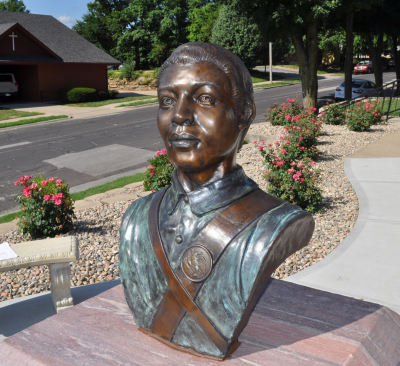
Cathay Williams’ bust–Leavenworth Kansas; Richard Allen Cultural Center
There is no gravestone. The wooden marker, if there ever was one, rotted away long ago. No monument existed until a bronze bust was dedicated in Leavenworth, Kansas at the Richard Allen Cultural Center and Museum in 2016 — 123 years after she likely died.
One hundred and twenty-three years.
The Army she served never paid her pension. The country she served never acknowledged her service while she lived. The frontier she helped tame with her boots and her labor and her silence and her endurance moved on without a backward glance.
What Cathay Williams wanted was simple. To work. To be free. To depend on no one. She got two out of three — the work and the freedom — for a time, and at a price no one who hadn’t paid it could really understand.
The third one, the not depending, she never quite got. Because in the end she had to depend on a government that had used her and forgotten her and sent a doctor with a clipboard and a form to finish the job.
It was a life: difficult, challenging, tragic, inspiring, brief. She asked for little, and got even less.
She deserved better.
Joe Girard © 2026
Thank you for reading. As always, you can add yourself to the notification list for newly published material by clicking here . Or emailing joe@girardmeister.com
Footnotes
[1] The identity of Cathay’s father is unrecorded beyond his status as a “free man.” In antebellum Missouri, that designation most commonly applied to free Black men, who existed in small but documented numbers in the state under significant legal restrictions. It is also possible — and not uncommon in the slave South — that her father was white, a circumstance that rarely produced legal documentation of any kind. The photographs most widely circulated online as depicting Cathay Williams are of disputed provenance; historians have not verified a confirmed likeness of her. What the record does tell us is that under the legal doctrine of partus sequitur ventrem — the child follows the mother — her father’s freedom conveyed nothing to her. Whatever he was, whoever he was, she was not his to protect.
[2] Only two people in the regiment were entrusted with the secret — a cousin and one close friend, both serving in Company A. Both kept it for two full years. That kind of loyalty, quiet and absolute, deserves its own recognition.
[3] The historical record confirms the initial rejection on February 8, 1892, and the subsequent medical examination in September 1892 — suggesting some form of appeal or review process occurred between the two. No documentation of a formal appeal by Williams has been located, but the sequence of events makes it the most plausible explanation. A woman who had her thieving husband arrested and jailed does not seem like someone who accepted a form letter without a fight.
[4] Historian Phillip Thomas Tucker’s estimate. The 38th marched from Fort Riley to Fort Harker to Fort Union to Fort Cummings to Fort Bayard — across Kansas and deep into New Mexico Territory — over the course of two years of service. Five hundred miles from Fort Harker to Fort Union alone, in the summer of 1867.
[5] The pension denial was made on the grounds that no disability existed — not on the grounds that her enlistment was illegal because she was a woman. There was precedent for granting pensions to female soldiers: Deborah Sampson (1816), Anna Maria Lane, and Mary Hayes McCauley — better known as Molly Pitcher — had all received pensions for Revolutionary War service. The Pension Bureau chose the least defensible grounds available and used them anyway.
[6] The process Cathay Williams navigated was standard procedure for the era — file a declaration, wait for the War Department to verify service records, receive a paper determination, then submit to a physical examination if the claim advanced. What was not standard was her odds. By 1893, more than 900,000 persons were on the pension rolls, consuming the largest single line item in the federal budget. The Bureau was under intense political pressure to control costs and root out fraud, employing hundreds of special examiners specifically to find reasons to deny claims. Into this system walked a Black woman with an unusual claim — and the system had well-documented tools for handling that. Scholarly research has established that local physicians rejected Black veterans’ applications at higher rates than white ones, and that Washington officials compounded the discrimination, developing what one study described as a bias against the “downtrodden races.” The initial paper denial before anyone examined her was not neglect — it was procedure. The “nil” disability rating after examining a woman on crutches with amputated toes and twenty years of smallpox damage was not an oversight. It was the system working as designed, for the people it was designed to serve. Cathay Williams was not among them.
Author’s Notes
- The primary source for Cathay Williams’s own words is the St. Louis Daily Times interview of January 2, 1876. It is the only first-person account she ever gave. The ‘played sick’ quote and the ‘men acted real bad’ quote both come from this interview. The first is a confession of exhaustion; the second is old anger, finally finding air.
- The pension file — including the February 1892 rejection and the September 1892 medical examination — survives in federal records. The doctor’s ‘nil’ disability rating is documented. The affidavits of Corporal James Richards and Private James Webster are part of the same file. No written explanation for the final denial survives beyond the finding that she “did not qualify.”
- Sources differ on exact dates of birth (1842, 1844, or 1848 appear in various records), and on the precise timeline of her post-Army life. I have used the dates most consistently supported across multiple historical accounts. She disappears from Trinidad census records after 1892, suggesting she died before 1900.
- The life of Cathay Williams is most thoroughly treated in Phillip Thomas Tucker’s biography: Cathay Williams: From Slave to Female Buffalo Soldier (2002). The buffalosoldier.net archive, which reproduces and annotates the original pension file documents, was invaluable in reconstructing the pension denial sequence.
- This essay was researched with the assistance of Claude, an AI developed by Anthropic. Claude was also used for editing. The historical judgment, structure, voice, and final text are completely the author’s.
Pension rejected