In June of 2009, I found myself near Greeley, Colorado chasing storms across the northeastern Colorado plains with an excited sixteen-year-old boy who was in my care. He thought he was ready for whatever the prairie sky could deliver. Mostly because he trusted me. His mother, far away in Germany, trusted me too. I chose not to think too hard about that.
Under angry skies, we chased the storm east, going as fast as I dare on US Highway 34, trying to not hydroplane, paying little attention to the country roads, which ran only in the cardinal directions. Along 34 I spied a simple sign in the grass off the side of the highway that seemed to be there for no reason at all. I slowed and squinted through the rain spattered windscreen.
Dearfield.
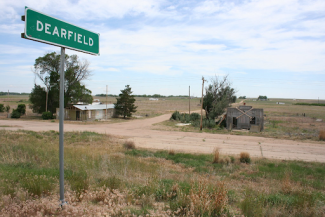
Roadside, Hwy 34
Then on we went. Chasing. Somewhere, at the end of a long gravel road, we caught it. The SatNav said there were no roads within miles. We were off the grid, in a cornfield. Wind bounced the car. Giant raindrops and pea-sized hail came down in torrents. For a moment we got out of the car. Bad idea. Back in.
The clouds swirled but never quite committed to a funnel. The corn stalks around us were laid flat — a crop lost in minutes. Wind and hail intensified. Finally about my wits, I turned us around. The lad was delighted, and graciously accepted my decision to depart.
In two minutes we were out of the worst of it, though the sky remained dark and threatening. The SatNav, confused by our adventure, still insisted we were nowhere.
Back on Highway 34, heading west now, I slowed again. There’s that sign, in the gloaming. The sign with a single word.
Dearfield.
* * *
Colorado’s relationship with water is old, contentious, and ruthlessly legal. Irrigation in Colorado stretches back over a millennium, but its continuous modern history begins in 1852, when descendants of Spanish settlers near San Luis built community-owned ditches called acequias, diverting water from the Rio Grande. By 1861, settlers along the South Platte were already furrowing ditches with horses, mules, and their own labor. Beginning in the 1860s, farmers dug long canals to deliver irrigation water strategically, feeding prospectors and settlers and growing Front Range cities in spite of the aridity.
Water law followed fast. Before statehood in 1876, water scarcity drove the territory to adopt the Colorado Doctrine — first in time, first in right. Ten years into statehood, the Platte was already over-appropriated. The system was elegant and merciless. File your claim, build your ditch, put water to beneficial use — and that right was yours in perpetuity, senior to anyone who came after. Following the Greeley colony’s example, settlers in the region had appropriated every last drop of water in the South Platte watershed by the turn of the twentieth century.
The Bijou Canal dates to 1864. Built to carry South Platte water out onto the high plains, it served an agricultural economy increasingly organized around one dominant money crop — sugar beets. The Great Western Sugar Company opened its Greeley factory in 1902, and the irrigated beet fields of Weld County spread outward from the river in every direction the ditches could reach. The water rights, the canal infrastructure, the contracts with Great Western — all of it was decades old, legally unassailable, and effectively closed to outsiders by the time Oliver Jackson arrived.
* * *
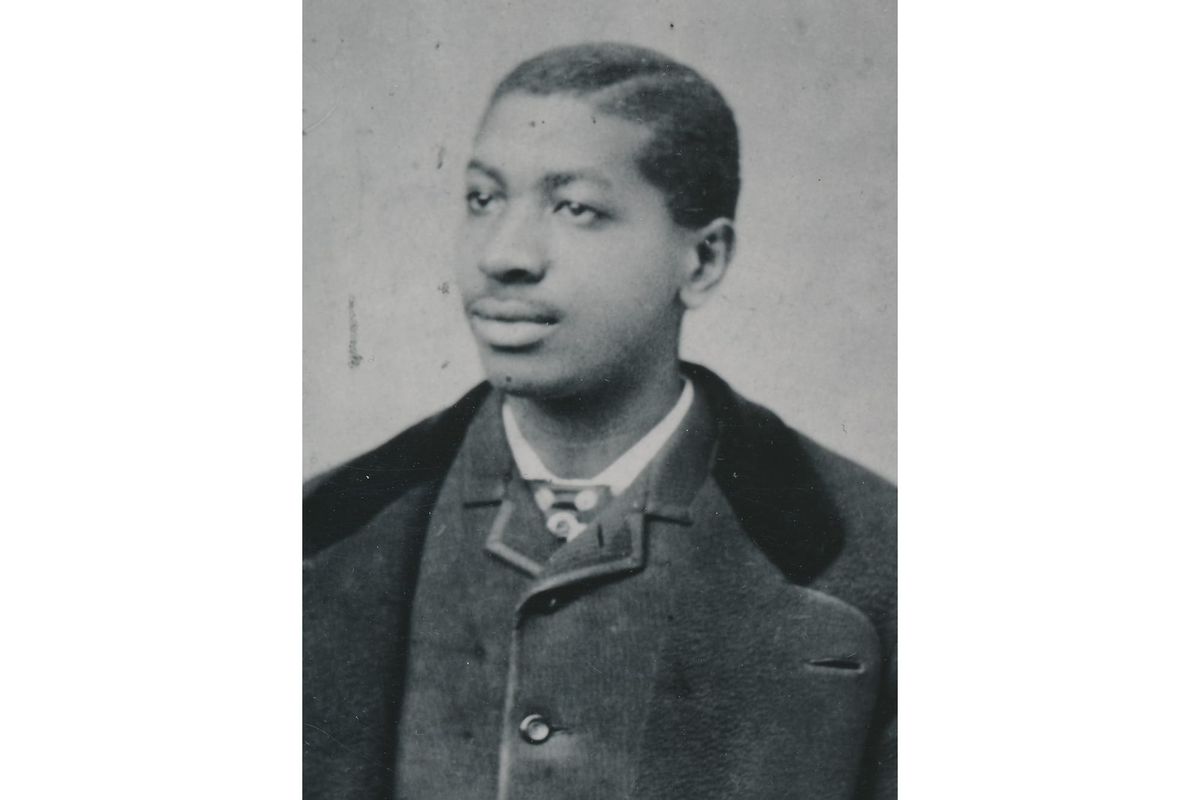
Oliver Jackson, young man
Oliver Toussaint Jackson was born on April 6, 1862, in Oxford, Ohio, the son of former slaves Hezekiah and Caroline Jackson. They named him after Toussaint L’Ouverture, the man who led the Haitian Revolution and overthrew French colonial rule in 1804. L’Ouverture means “the opening.” The parents of a child born into American freedom in 1862 chose to name him after the most famous liberator in the Black world, “the Opener.” That is not an accident. That is a declaration. He would lead the way. [1]
Hezekiah had learned to read and made sure all six of his children did too. Then tragedy struck. In 1868, Jackson’s mother gave birth to twin boys, but she died suddenly six weeks after their birth. The following month, both twins died of cholera, a day apart from each other. Oliver was six years old. [2]
He grew up fast, learned the catering and restaurant trade as a young man, and at twenty-five did what an entire generation would do after him. He went West. He moved to Denver, which had a population that soared from 4,579 in 1870 to 106,713 by 1890, and got a job as a caterer. He opened restaurants on the Front Range. He ran a resort farm near Boulder. He was entrepreneurial, restless, and politically minded. [3]
Then he read a book. Not just any book.
Inspired by Booker T. Washington’s 1901 autobiography Up From Slavery, Jackson increasingly came to believe that the destiny of Denver’s African Americans lay with a return to farming. Washington’s argument was blunt and practical — land ownership was the foundation of true freedom. A man who owned his land owed no one. A man who worked someone else’s land was still, in every practical sense, not free. [4]
Jackson looked at Denver’s Black community and saw wage workers, domestics, caterers — people dependent on white employers for their livelihoods, vulnerable to every economic tide. He looked at the Colorado plains stretching east of Greeley and saw something else. Available land. Federal homestead claims still to be filed. Room enough for a colony.
He dug into the law and found his instrument — the Enlarged Homestead Act of 1909, which granted 320 acres of dryland prairie to any qualified claimant willing to farm it. Twice the acreage of the original 1862 Homestead Act, because Congress itself understood that dryland farming required more ground to be viable. Jackson saw the opportunity. He filed his research away like a legal brief and went to work.
But the state land office had other ideas. His requests were ignored because he was Black. Jackson didn’t stop. He had spent years working as a messenger for Colorado governors, earning political capital one relationship at a time. He eventually secured the help of Governor John F. Shafroth and obtained land for his colony. [5]
In December 1909 he formed the Negro Townsite and Land Company. That year Dr. Joseph H.P. Westbrook of Denver, one of the first settlers, remarked that the colony “will be very dear to us,” thus giving the new community its name.
Dearfield.
Then Jackson went to work recruiting. He advertised in Denver’s Black newspapers. He preached the dream in churches. He wrote letters. He campaigned for Democratic politicians and earned access to multiple politicians’ offices and ears. He convinced the Department of Agriculture to provide seeds. He was, by every account, a man of extraordinary energy and persuasion — a visionary who happened also to be a superb salesman. [6]
What he was selling was the oldest American promise. Land. Independence. The chance to build something that was yours.
People believed him. They had reason to. He believed it himself, completely and without reservation, for the rest of his long life.
* * *
In 1911 the first settlers arrived — seven families, three teams of horses, and very little else. Some were so poor they could not ship their belongings from Denver and walked part of the way. Others lived in tents or in holes dug into the hillside while they built. The winters were brutal. Fuel was scarce. Water had to be carried from the South Platte River, less than a mile away.
That river was right there. They could see it. They could walk to it with a bucket.
And running directly alongside the Dearfield claim, as it had since 1864, was the Bijou Canal — carrying South Platte water out onto the irrigated plains of Weld County, past fields of sugar beets and corn owned by white farmers with senior water rights decades old. Jackson and his settlers were not thieves and they were not fools. They understood Colorado water law. They respected it. The canal ran through their world and they did not touch it.
Even junior water rights — the weakest, least reliable claim in the prior appropriation system, the rights that dried up first in any drought year — were almost certainly beyond their reach financially and legally. The water economy of the South Platte had been closed for a generation before they arrived. The Bijou Canal was not for them. The river was not for them. Not a drop of it, legally, was for them.
So they looked to the sky.
And for a while — a long, generous, deeply misleading while — the sky cooperated. The years from 1910 through the mid-1920s ran anomalously wet across the Colorado plains. Above average rainfall, year after year. The crops came in. Wheat and barley, yes — the tough dryland varieties built for thin moisture. But also corn. Also beans. Also, remarkably, melons — watermelons and cantaloupe growing fat on a dry farm twenty-five miles east of Greeley, proof, it seemed, that the dream was real and the land was good.
By 1921 Dearfield was home to 700 people and valued at nearly a million dollars. There were churches, a school, a dance hall, a lunchroom, a concrete block factory, a baseball team — one of the best in the region. Denver’s Black families came out on weekends by train to fish the South Platte and dance and eat and feel, for a few hours, what it was like to be in a place that belonged entirely to them. Plans were drawn for a cannery. Talk of a college.
The sky had been lying the whole time.
The wet years were an anomaly, not a promise — a two-decade deviation from the actual climate of the high plains that no one fully understood in 1910. The agricultural boosters, the government pamphlets, the extension agents from the state college — all of them had drawn their conclusions from borrowed weather and presented it as fact. When the cycle returned to normal in the mid-1920s the thirsty crops failed first. The melons. The corn. Then the hardier grains began to struggle. Then the Dust Bowl arrived — 1930 to 1934, the worst dry period in recorded Colorado history. The sky that had given so much gave nothing.
The Bijou Canal still flowed. The South Platte was still there, less than a mile away.
It didn’t matter. By 1940 twelve people remained in Dearfield. Oliver Jackson and his niece were among them.
* * *
Oliver Jackson didn’t leave.
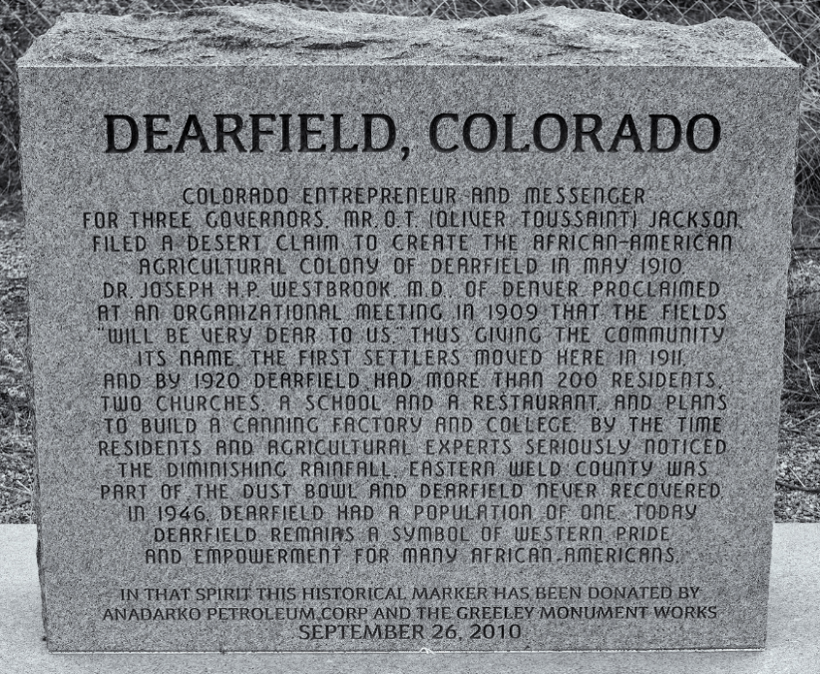 He tried everything. He rebranded Dearfield as a resort — the Valley Resort, a weekend destination for Denver’s Black families. He sold bottles of whiskey and beer to keep money coming in. For a time locals called it Beerfield, and O.T. Jackson probably smiled at that. He tried to sell the whole property to the federal government as an internment camp for Japanese-Americans during World War II. The offer was declined. He couldn’t find a buyer. He couldn’t find anyone willing to take over and run the place. So he stayed.
During the first winter, only two of the seven families had wooden houses and the suffering was intense. Buffalo chips and sagebrush were the chief fuel. Three horses died from starvation and the other three were too weak to pull the empty wagon. He had written those words describing the first winter of 1911. By the 1940s the suffering was quieter but no less complete. The buildings were coming down one by one — sold for lumber because lumber was scarce and the dream was gone. [7]
Oliver Toussaint Jackson died on February 8, 1948. He was 86 years old. He was buried in Linn Grove Cemetery in Greeley, a mile or two from the South Platte River he had never been permitted to irrigate from. His niece Jennie stayed on alone in Dearfield. She was the last resident. She died in 1973.
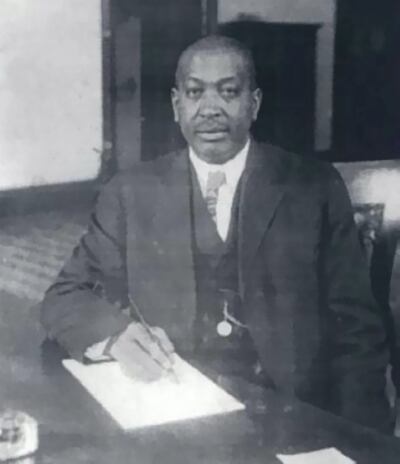
Jackson, older
After that, weather and vandals and time completed what the Dust Bowl had begun. What remained were a gas station, a diner, a blacksmith’s shop, a small cabin, a false-front building believed to be Jackson’s later residence, and the structural remains of Squire Brockman’s cabin — reached via a rough road that was once Dearfield’s Washington Avenue. The plains wind worked at them steadily. In 2020 a microburst took down one building entirely and damaged the roof of Jackson’s home. [8]
In 1995 Dearfield was listed on the National Register of Historic Places. In 1999 Colorado Preservation Inc. named it one of the state’s Most Endangered Places. The Black American West Museum has been acquiring the property piece by piece. Scholars from the University of Northern Colorado have been doing archaeological work on the site for decades. There is talk — serious talk — of a National Park designation. Senator Hickenlooper and others have introduced legislation.
It would be long overdue. Black stories often go untold and sites related to Black history are often not preserved. The phenomenon is so pervasive it has its own name — the Preservation Diversity Gap. [9]
Dearfield is the gap made visible. A town that peaked at 700 people, worth nearly a million dollars, built by the children and grandchildren of slaves on land nobody else wanted, sustained by borrowed rain, destroyed by drought, and nearly erased by a century of indifference.
The Bijou Canal still runs alongside the property. The South Platte is still less than a mile away.
* * *
I know all of this now. I didn’t know any of it in June of 2009, squinting through a rain-spattered windshield at a marker in the grass, a delighted boy beside me, the darkest clouds of the storm still ahead of us.
I know now that the cornfield we ended up in — hail destroying the rows around us, the boy thrilled, me questioning my judgment — was irrigated. Of course it was irrigated; the farmer was growing corn — a very thirsty crop — in a near-desert. Center pivot. South Platte water, senior rights, the whole apparatus. The farmer who owned that field had something Oliver Jackson never did. Water rights.
We drove back west, again past the marker, in the early evening. The sky was still dark with clouds, and getting darker, the unseen sun drifting low over the equally invisible Rocky Mountains. Eighty miles from supper, from home. There was nothing to stop for. Just a sign in the rain, and a word I didn’t yet understand.
Dearfield.
Joe Girard © 2026
Thank you for reading. As always, you can add yourself to the notification list for newly published material by clicking here . Or emailing joe@girardmeister.com
[1]https://coloradoencyclopedia.org/article/oliver-tousaint-jackson
[2]https://www.deseret.com/2022/12/30/23508635/dearfield-colorado-black-history/
https://www.oxfreepress.com/local-legends-the-persistent-dream/
[3]Ibid, Deseret news
[4]https://blackpast.org/african-american-history/jackson-oliver-toussaint-1862-1948/
[6]https://5280.com/dearfield-the-story-of-colorados-historic-all-black-settlement/
[7]Blackpast.org, same
[8] Colorado Encyclopedia
[9] https://pehc.colostate.edu/2022/03/dearfield-colorados-almost-forgotten-black-ghost-town/
More:
Enlarged Homestead Act: https://sk.sagepub.com/ency/edvol/immigration/chpt/enlarged-homestead-act-1909#_