Monthly Archives: May 2026

Dearfield—Lying Rain

In June of 2009, I found myself near Greeley, Colorado chasing storms across the northeastern Colorado plains with an excited sixteen-year-old boy who was in my care. He thought he was ready for whatever the prairie sky could deliver. Mostly because he trusted me. His mother, far away in Germany, trusted me too. I chose not to think too hard about that.

Under angry skies, we chased the storm east, going as fast as I dare on US Highway 34, trying to not hydroplane, paying little attention to the country roads, which ran only in the cardinal directions. Along 34 I spied a simple sign in the grass off the side of the highway that seemed to be there for no reason at all. I slowed and squinted through the rain spattered windscreen.

Dearfield.
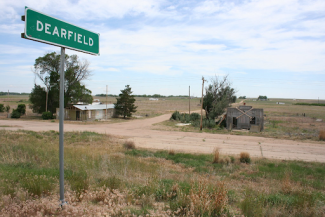
Roadside, Hwy 34

Then on we went. Chasing. Somewhere, at the end of a long gravel road, we caught it. The SatNav said there were no roads within miles. We were off the grid, in a cornfield. Wind bounced the car. Giant raindrops and pea-sized hail came down in torrents. For a moment we got out of the car. Bad idea. Back in.

The clouds swirled but never quite committed to a funnel. The corn stalks around us were laid flat — a crop lost in minutes. Wind and hail intensified. Finally about my wits, I turned us around. The lad was delighted, and graciously accepted my decision to depart.

In two minutes we were out of the worst of it, though the sky remained dark and threatening. The SatNav, confused by our adventure, still insisted we were nowhere.

Back on Highway 34, heading west now, I slowed again. There’s that sign, in the gloaming. The sign with a single word.

Dearfield.

* * *

Colorado’s relationship with water is old, contentious, and ruthlessly legal. Irrigation in Colorado stretches back over a millennium, but its continuous modern history begins in 1852, when descendants of Spanish settlers near San Luis built community-owned ditches called acequias, diverting water from the Rio Grande. By 1861, settlers along the South Platte were already furrowing ditches with horses, mules, and their own labor. Beginning in the 1860s, farmers dug long canals to deliver irrigation water strategically, feeding prospectors and settlers and growing Front Range cities in spite of the aridity.

Water law followed fast. Before statehood in 1876, water scarcity drove the territory to adopt the Colorado Doctrine — first in time, first in right. Ten years into statehood, the Platte was already over-appropriated. The system was elegant and merciless. File your claim, build your ditch, put water to beneficial use — and that right was yours in perpetuity, senior to anyone who came after. Following the Greeley colony’s example, settlers in the region had appropriated every last drop of water in the South Platte watershed by the turn of the twentieth century.

The Bijou Canal dates to 1864. Built to carry South Platte water out onto the high plains, it served an agricultural economy increasingly organized around one dominant money crop — sugar beets. The Great Western Sugar Company opened its Greeley factory in 1902, and the irrigated beet fields of Weld County spread outward from the river in every direction the ditches could reach. The water rights, the canal infrastructure, the contracts with Great Western — all of it was decades old, legally unassailable, and effectively closed to outsiders by the time Oliver Jackson arrived.

* * *
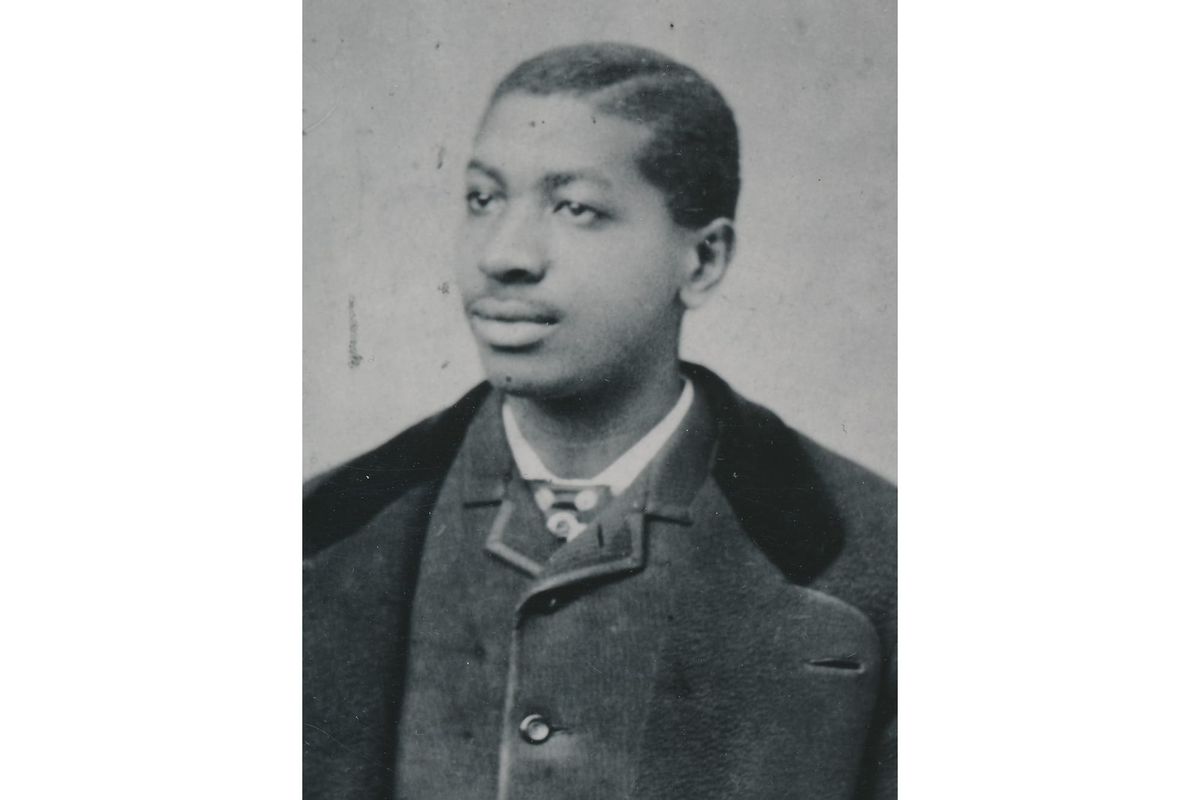
Oliver Jackson, young man

Oliver Toussaint Jackson was born on April 6, 1862, in Oxford, Ohio, the son of former slaves Hezekiah and Caroline Jackson. They named him after Toussaint L’Ouverture, the man who led the Haitian Revolution and overthrew French colonial rule in 1804. L’Ouverture means “the opening.” The parents of a child born into American freedom in 1862 chose to name him after the most famous liberator in the Black world, “the Opener.” That is not an accident. That is a declaration. He would lead the way. [1]

Hezekiah had learned to read and made sure all six of his children did too. Then tragedy struck. In 1868, Jackson’s mother gave birth to twin boys, but she died suddenly six weeks after their birth. The following month, both twins died of cholera, a day apart from each other. Oliver was six years old. [2]

He grew up fast, learned the catering and restaurant trade as a young man, and at twenty-five did what an entire generation would do after him. He went West. He moved to Denver, which had a population that soared from 4,579 in 1870 to 106,713 by 1890, and got a job as a caterer. He opened restaurants on the Front Range. He ran a resort farm near Boulder. He was entrepreneurial, restless, and politically minded. [3]

Then he read a book. Not just any book.

Inspired by Booker T. Washington’s 1901 autobiography Up From Slavery, Jackson increasingly came to believe that the destiny of Denver’s African Americans lay with a return to farming. Washington’s argument was blunt and practical — land ownership was the foundation of true freedom. A man who owned his land owed no one. A man who worked someone else’s land was still, in every practical sense, not free. [4]

Jackson looked at Denver’s Black community and saw wage workers, domestics, caterers — people dependent on white employers for their livelihoods, vulnerable to every economic tide. He looked at the Colorado plains stretching east of Greeley and saw something else. Available land. Federal homestead claims still to be filed. Room enough for a colony.

He dug into the law and found his instrument — the Enlarged Homestead Act of 1909, which granted 320 acres of dryland prairie to any qualified claimant willing to farm it. Twice the acreage of the original 1862 Homestead Act, because Congress itself understood that dryland farming required more ground to be viable. Jackson saw the opportunity. He filed his research away like a legal brief and went to work.

But the state land office had other ideas. His requests were ignored because he was Black. Jackson didn’t stop. He had spent years working as a messenger for Colorado governors, earning political capital one relationship at a time. He eventually secured the help of Governor John F. Shafroth and obtained land for his colony. [5]

In December 1909 he formed the Negro Townsite and Land Company. That year Dr. Joseph H.P. Westbrook of Denver, one of the first settlers, remarked that the colony “will be very dear to us,” thus giving the new community its name.

Dearfield.

Then Jackson went to work recruiting. He advertised in Denver’s Black newspapers. He preached the dream in churches. He wrote letters. He campaigned for Democratic politicians and earned access to multiple politicians’ offices and ears. He convinced the Department of Agriculture to provide seeds. He was, by every account, a man of extraordinary energy and persuasion — a visionary who happened also to be a superb salesman. [6]

What he was selling was the oldest American promise. Land. Independence. The chance to build something that was yours.

People believed him. They had reason to. He believed it himself, completely and without reservation, for the rest of his long life.

* * *

In 1911 the first settlers arrived — seven families, three teams of horses, and very little else. Some were so poor they could not ship their belongings from Denver and walked part of the way. Others lived in tents or in holes dug into the hillside while they built. The winters were brutal. Fuel was scarce. Water had to be carried from the South Platte River, less than a mile away.

That river was right there. They could see it. They could walk to it with a bucket.

And running directly alongside the Dearfield claim, as it had since 1864, was the Bijou Canal — carrying South Platte water out onto the irrigated plains of Weld County, past fields of sugar beets and corn owned by white farmers with senior water rights decades old. Jackson and his settlers were not thieves and they were not fools. They understood Colorado water law. They respected it. The canal ran through their world and they did not touch it.

Even junior water rights — the weakest, least reliable claim in the prior appropriation system, the rights that dried up first in any drought year — were almost certainly beyond their reach financially and legally. The water economy of the South Platte had been closed for a generation before they arrived. The Bijou Canal was not for them. The river was not for them. Not a drop of it, legally, was for them.

So they looked to the sky.

And for a while — a long, generous, deeply misleading while — the sky cooperated. The years from 1910 through the mid-1920s ran anomalously wet across the Colorado plains. Above average rainfall, year after year. The crops came in. Wheat and barley, yes — the tough dryland varieties built for thin moisture. But also corn. Also beans. Also, remarkably, melons — watermelons and cantaloupe growing fat on a dry farm twenty-five miles east of Greeley, proof, it seemed, that the dream was real and the land was good.

By 1921 Dearfield was home to 700 people and valued at nearly a million dollars. There were churches, a school, a dance hall, a lunchroom, a concrete block factory, a baseball team — one of the best in the region. Denver’s Black families came out on weekends by train to fish the South Platte and dance and eat and feel, for a few hours, what it was like to be in a place that belonged entirely to them. Plans were drawn for a cannery. Talk of a college.

The sky had been lying the whole time.

The wet years were an anomaly, not a promise — a two-decade deviation from the actual climate of the high plains that no one fully understood in 1910. The agricultural boosters, the government pamphlets, the extension agents from the state college — all of them had drawn their conclusions from borrowed weather and presented it as fact. When the cycle returned to normal in the mid-1920s the thirsty crops failed first. The melons. The corn. Then the hardier grains began to struggle. Then the Dust Bowl arrived — 1930 to 1934, the worst dry period in recorded Colorado history. The sky that had given so much gave nothing.

The Bijou Canal still flowed. The South Platte was still there, less than a mile away.

It didn’t matter. By 1940 twelve people remained in Dearfield. Oliver Jackson and his niece were among them.

* * *

Oliver Jackson didn’t leave.
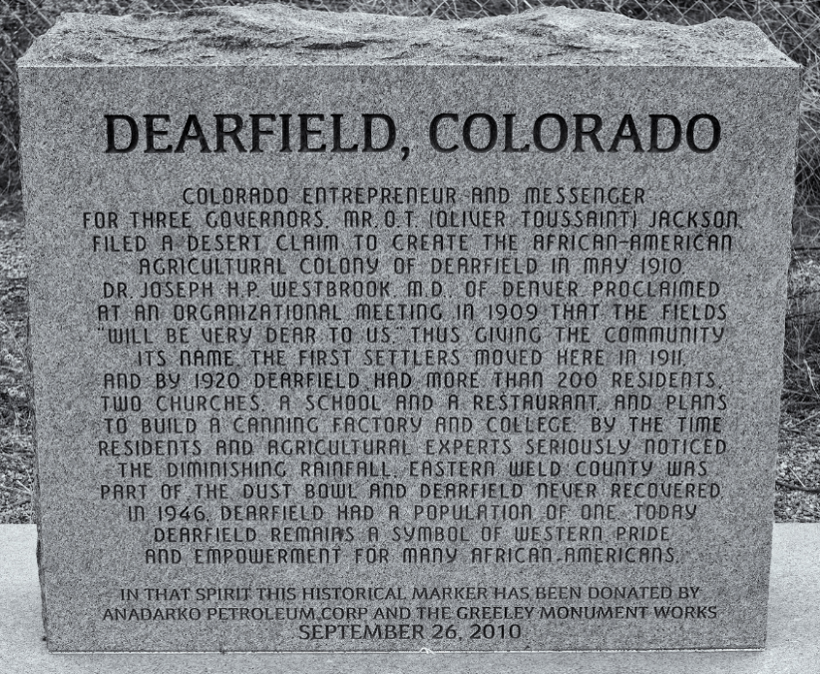
He tried everything. He rebranded Dearfield as a resort — the Valley Resort, a weekend destination for Denver’s Black families. He sold bottles of whiskey and beer to keep money coming in. For a time locals called it Beerfield, and O.T. Jackson probably smiled at that. He tried to sell the whole property to the federal government as an internment camp for Japanese-Americans during World War II. The offer was declined. He couldn’t find a buyer. He couldn’t find anyone willing to take over and run the place. So he stayed.

During the first winter, only two of the seven families had wooden houses and the suffering was intense. Buffalo chips and sagebrush were the chief fuel. Three horses died from starvation and the other three were too weak to pull the empty wagon. He had written those words describing the first winter of 1911. By the 1940s the suffering was quieter but no less complete. The buildings were coming down one by one — sold for lumber because lumber was scarce and the dream was gone. [7]

Oliver Toussaint Jackson died on February 8, 1948. He was 86 years old. He was buried in Linn Grove Cemetery in Greeley, a mile or two from the South Platte River he had never been permitted to irrigate from. His niece Jennie stayed on alone in Dearfield. She was the last resident. She died in 1973.
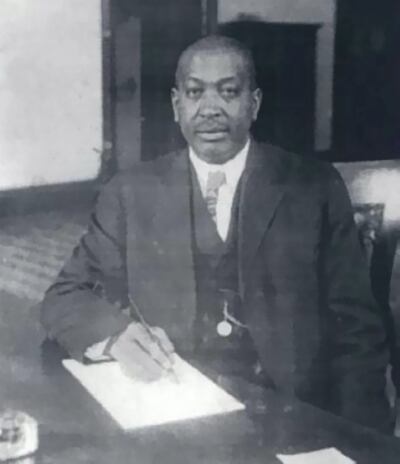
Jackson, older

After that, weather and vandals and time completed what the Dust Bowl had begun. What remained were a gas station, a diner, a blacksmith’s shop, a small cabin, a false-front building believed to be Jackson’s later residence, and the structural remains of Squire Brockman’s cabin — reached via a rough road that was once Dearfield’s Washington Avenue. The plains wind worked at them steadily. In 2020 a microburst took down one building entirely and damaged the roof of Jackson’s home. [8]

In 1995 Dearfield was listed on the National Register of Historic Places. In 1999 Colorado Preservation Inc. named it one of the state’s Most Endangered Places. The Black American West Museum has been acquiring the property piece by piece. Scholars from the University of Northern Colorado have been doing archaeological work on the site for decades. There is talk — serious talk — of a National Park designation. Senator Hickenlooper and others have introduced legislation.

It would be long overdue. Black stories often go untold and sites related to Black history are often not preserved. The phenomenon is so pervasive it has its own name — the Preservation Diversity Gap. [9]

Dearfield is the gap made visible. A town that peaked at 700 people, worth nearly a million dollars, built by the children and grandchildren of slaves on land nobody else wanted, sustained by borrowed rain, destroyed by drought, and nearly erased by a century of indifference.

The Bijou Canal still runs alongside the property. The South Platte is still less than a mile away.

* * *

I know all of this now. I didn’t know any of it in June of 2009, squinting through a rain-spattered windshield at a marker in the grass, a delighted boy beside me, the darkest clouds of the storm still ahead of us.

I know now that the cornfield we ended up in — hail destroying the rows around us, the boy thrilled, me questioning my judgment — was irrigated. Of course it was irrigated; the farmer was growing corn — a very thirsty crop — in a near-desert. Center pivot. South Platte water, senior rights, the whole apparatus. The farmer who owned that field had something Oliver Jackson never did. Water rights.

We drove back west, again past the marker, in the early evening. The sky was still dark with clouds, and getting darker, the unseen sun drifting low over the equally invisible Rocky Mountains. Eighty miles from supper, from home. There was nothing to stop for. Just a sign in the rain, and a word I didn’t yet understand.

Dearfield.

Joe Girard © 2026

Thank you for reading. As always, you can add yourself to the notification list for newly published material by clicking here . Or emailing joe@girardmeister.com


[1]https://coloradoencyclopedia.org/article/oliver-tousaint-jackson

[2]https://www.deseret.com/2022/12/30/23508635/dearfield-colorado-black-history/
https://www.oxfreepress.com/local-legends-the-persistent-dream/

[3]Ibid, Deseret news

[4]https://blackpast.org/african-american-history/jackson-oliver-toussaint-1862-1948/

[5]Colorado Encyclopedia

[6]https://5280.com/dearfield-the-story-of-colorados-historic-all-black-settlement/

[7]Blackpast.org, same

[8] Colorado Encyclopedia

[9] https://pehc.colostate.edu/2022/03/dearfield-colorados-almost-forgotten-black-ghost-town/

More:
Enlarged Homestead Act: https://sk.sagepub.com/ency/edvol/immigration/chpt/enlarged-homestead-act-1909#_
Pat’s Lead

Clair Patterson — The Man Who Dated the Earth and Then Tried to Save It

Lead

It is one of the oldest metals in human civilization — soft, heavy, bluish-gray, and almost absurdly easy to work with. It melts at a temperature a campfire can reach. It resists corrosion. It bends without breaking. It is abundant, cheap, and the ancients loved it.

The Romans called it plumbum — which is why the man who fixes your pipes is a plumber, and why lead’s symbol on the periodic table is Pb. It is heavy — the weighted string a builder uses to find true vertical is still called a plumb bob. They used it everywhere: aqueducts, cookware, wine vessels, roofing, coins, water pipes running beneath entire cities. They even sweetened their wine with it. Lead acetate — “sugar of lead” — is genuinely sweet to the taste, and Roman winemakers boiled their grape must in lead pots to produce a syrup added to virtually everything the affluent table required. The aristocracy was, at every feast, micro-dosing themselves with a neurotoxin. It probably led to the Fall of Rome.

The industrial revolution changed the scale entirely. And then, in 1921, a chemist named Thomas Midgley Jr. working for General Motors discovered that adding tetraethyl lead to gasoline stopped engines from knocking. By the early 1970s, the United States alone was pumping more than 270,000 tons of lead into the air every year. Every breath taken in every American city carried lead in it. Almost no one understood what was happening.

Almost no one.

A metal that seduced every civilization it touched, for eight thousand years, before a farm boy from Iowa finally told the truth about it.

Mitchellville, Iowa. 1922

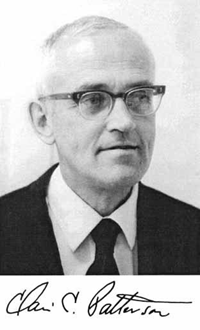
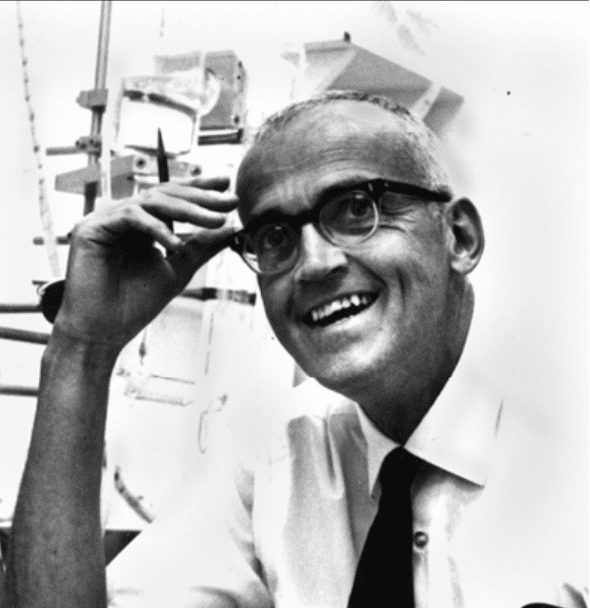
Clair Cameron Patterson — “Pat” to everyone who knew him — was born June 2, 1922, in Mitchellville, Iowa, a small town of a few hundred souls just east of Des Moines. His father was a postal carrier, a man Pat later described as “a contentious intellectual Scot.” His mother served on the local school board. He had a brother, Paul, and a sister, Patricia.

Clair C Patterson, known to all as Pat

There were no cars in Mitchellville when Pat was young. Fewer than a hundred children attended his school. Weekends meant walking four miles to the Skunk River to fish, hunt squirrels, build fires, and camp without adult supervision. It was a Tom Sawyer boyhood.

His mother gave him a chemistry set. He descended to the basement and began mixing things to see what happened. He found his uncle’s chemistry textbook and read it cover to cover. By eighth grade he was correcting his science teachers.

He graduated high school at sixteen, went to Grinnell College — close enough that he hitchhiked home to do his laundry — and graduated in 1943 with a degree in chemistry. At Grinnell he met Lorna McCleary, who went by Laurie, and who would become his wife, his partner, and in the lean years ahead, the family’s primary breadwinner while Pat chased bigger questions.

He earned his master’s degree in molecular spectroscopy from the University of Iowa in nine months. The Army draft board took note and made a decision: this one was more valuable in a laboratory than a foxhole.

They sent him to Oak Ridge, Tennessee.


Oak Ridge, Tennessee. 1944

Oak Ridge lies in a valley between the Cumberland and Great Smoky mountains, about twenty miles west of Knoxville. It is a beautiful setting — forested ridges, clean rivers, the kind of East Tennessee landscape that feels ancient and unhurried. In 1942, the Army Corps of Engineers arrived, bought 60,000 acres of farmland at roughly $47 an acre, evicted the families who lived there, and built a city of 75,000 people that did not appear on any map. They called it the Secret City. Most residents had no idea what they were actually building.

Pat Patterson knew. His job at the Y-12 plant was uranium isotope separation — specifically, the problem that made the atomic bomb both possible and extraordinarily difficult. Uranium comes in two forms. Uranium-238 is the common variety, comprising more than 99 percent of all uranium on earth. Uranium-235 is the rare one — chemically identical, differing only in the number of neutrons in its nucleus — and it is the one that splits violently enough to level a city. The mass spectrometer sorted them. Feed uranium atoms into a magnetic field and the heavier ones curve differently than the lighter ones — the machine reads the difference the way a river sorts sand from gravel. Patterson worked those instruments in the Tennessee valley, separating the useful from the useless.

Here is the detail worth pausing on. U-238 does decay — slowly, steadily, emitting particles on its way to becoming something else entirely. It is just extraordinarily patient about it, with a half-life of 4.5 billion years. That patience makes it useless for a bomb. It also makes it a perfect geological clock. The same physics that rendered U-238 irrelevant to the Manhattan Project would later hand Patterson the key to one of science’s oldest questions.

He didn’t know that yet. He was still in Tennessee, separating isotopes, contributing his small piece to what would become the bomb dropped on Hiroshima.

He was horrified when it fell.

After the war, he returned to Chicago to finish his doctorate — no longer separating isotopes to end lives, but to find the age of the earth. The mass spectrometer remained his instrument. The element he would measure remained lead. But the question had changed entirely.


Chicago. 1946

His mentor at the University of Chicago was Harrison Brown, a geochemist with a compelling idea and a gift for understatement. Brown believed he had found a way to determine the age of the earth — by measuring the ratio of uranium to lead in ancient rocks. Uranium decays into lead at a known, fixed rate. Measure how much uranium remains and how much lead has accumulated, and you can calculate how long the process has been running. Simple in concept. Staggeringly difficult in practice.

Brown handed the project to Patterson and a colleague, George Tilton. The key was zircon — a mineral with a remarkable property. When zircon crystals form, they incorporate uranium but reject lead entirely. None. So any lead found in a zircon sample must have arrived there one way: through the radioactive decay of uranium, over geological time. The lead was the clock. Patterson’s job was to read it.

“Duck soup,” Brown told him.

It took seven years.

The problem was contamination. Patterson was trying to measure lead at almost unimaginably small concentrations — and lead was everywhere. In the air. In the dust. In the glassware. In the water. In the reagents. In the old Kent Hall laboratory building itself, with its decades of accumulated grime. Every time he prepared a sample, background lead swamped his measurements. His data was useless. He couldn’t find the earth’s age because he couldn’t find the earth’s lead — it was buried under the noise of everyone else’s.

He found something else instead.

The lead contaminating his samples wasn’t geological. It was industrial. It was everywhere in the modern world in quantities that had no natural explanation. He filed that observation away and kept working. There was still an age to find.


Pasadena, California. 1952

Patterson, in his Cal Tech lab, 1960s

Brown moved to Caltech and brought Patterson with him. Pat built his laboratory from scratch — and this time he built it differently. He sealed every point of entry against outside air. He acid-washed every piece of equipment. He distilled his own chemicals rather than trust commercial supplies. He was creating, essentially by necessity, one of the first scientific clean rooms ever built — not for safety, but for silence. He needed a laboratory quiet enough to hear a whisper of ancient lead above the roar of modern contamination.

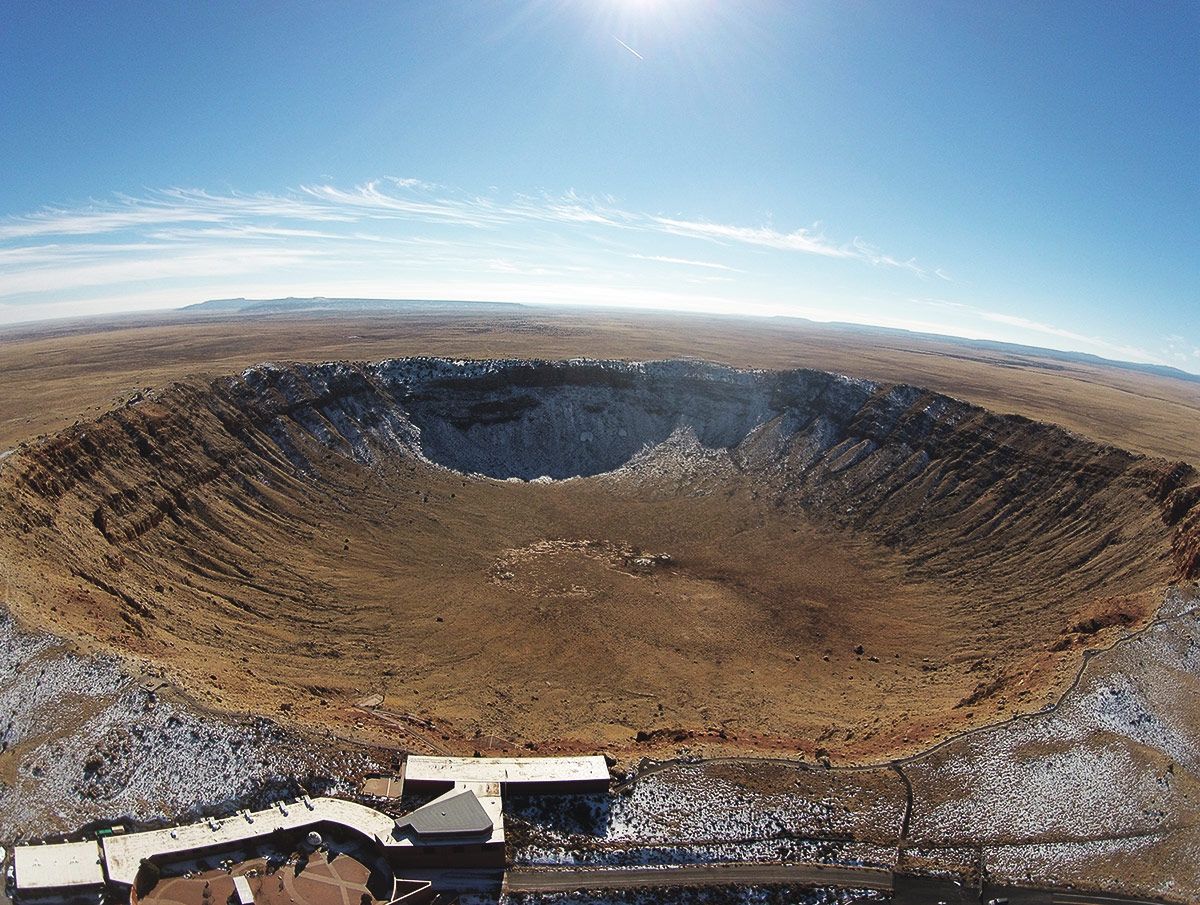
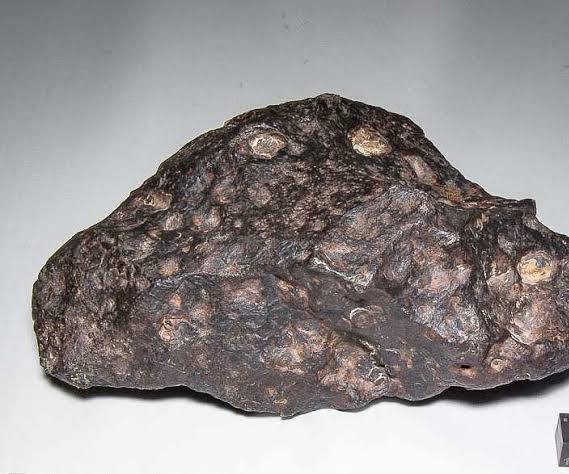
The Canyon Diablo meteorite had fallen to earth 50,000 years ago near what is now Meteor Crater, Arizona. It was, in geological terms, pristine — a fragment of the original solar system, largely unchanged since the planets formed. Patterson obtained samples, prepared them in his clean room, and ran them through the mass spectrometer. The lead isotopes told their story. The uranium had been decaying for a very long time indeed.

Meteor Crater, Arizona — where the Canyon Diablo meteorite struck 50,000 years ago

In 1956, he published his answer: the earth was 4.55 billion years old, give or take 70 million years. [1]

The previous best estimate had been around 3.3 billion. Patterson hadn’t just refined the number — he had redrawn the timeline of existence. His figure has not meaningfully changed in nearly seventy years.

He could have stopped there. Any scientist alive would have been satisfied. But the contamination problem that had plagued him for years wouldn’t leave him alone. His clean room had given him the answer he needed — and in doing so had shown him something else entirely. The difference between the lead levels inside his sealed laboratory and the lead levels in the world outside was not subtle. The outside world was saturated. Not geologically. Industrially.

Fragment of the Canyon Diablo meteorite — the ancient rock that told us how old we are

The farm boy from Iowa had stumbled onto the second great question of his career — and this one had an enemy attached to it.


The Knock

An internal combustion engine works by compressing a fuel-air mixture and igniting it at precisely the right moment. When the mixture ignites too early — before the spark plug fires — the result is a sharp metallic rapping from inside the engine. Drivers called it knocking, or pinging. It robbed engines of power, damaged cylinders, and unnerved customers. By the early 1920s it was the automobile industry’s most pressing engineering problem.

A General Motors chemist named Thomas Midgley Jr. tried hundreds of substances looking for a solution — melted butter, camphor, iodine, aniline. On December 9, 1921, he added a few drops of tetraethyl lead to a test engine’s fuel. The knock vanished. Midgley and his colleagues, it is said, danced “a very unscientific jig” in celebration.

Flying A Ethyl Gasoline pump, circa 1950s. The “Ethyl” brand name — chosen to obscure its lead content — appeared on pumps across dozens of gasoline brands for fifty years

The fix worked by raising what we now call the octane rating — the temperature at which the fuel ignites, giving the piston time to complete its stroke before combustion occurs. A tiny amount of lead, one part per 1,300 of gasoline, was all it took. It was cheap, it was effective, and General Motors, Standard Oil, and DuPont moved quickly to commercialize it through a joint venture they called, with deliberate blandness, the Ethyl Gasoline Corporation.

There was an alternative. Ethanol raised octane just as effectively. But ethanol couldn’t be patented, and anyone could make it. Tetraethyl lead could be controlled and patented. The choice was commercial, not scientific — and it was made knowing full well that lead was poisonous. A DuPont executive described TEL in 1922 as “a colorless liquid of sweetish odor, very poisonous if absorbed through the skin.” When workers at the Bayway, New Jersey plant began hallucinating and dying of acute lead poisoning in 1924, Midgley held a press conference. He poured TEL over his hands, held a bottle under his nose, and inhaled it for sixty seconds. He declared he could do this every day without harm. [2]

The first tank of leaded gasoline had gone on sale the previous year. It would be over fifty more years before the last one did.

* * *

Lead is a remarkably effective impostor. In the body, it mimics calcium—similar electronic charge [3], similar size—and the body’s transport systems cannot reliably tell them apart. Lead rides those systems straight into bones, teeth, and across the blood-brain barrier into the brain itself. Once lodged in bone it can stay for decades, slowly leaching back into the bloodstream throughout a lifetime. It interferes with the formation of red blood cells, reducing their ability to carry oxygen. In the brain it disrupts the neural processes that govern learning, memory, and impulse control. In children, whose developing nervous systems absorb it faster and more completely than adults, even low levels cause measurable reductions in IQ and lasting behavioral damage. There is no safe level. There never was.

All of this was being pumped into the air of every American city, every day, by every car on the road.

Patterson knew. The question was whether anyone would listen.

* * *

The Find

Patterson hadn’t set out to save anyone. He was still trying to understand lead — specifically, whether the contamination swamping his clean room samples was geological or something else entirely. In 1963 he published a paper in Nature laying out what he had found in ocean water and polar ice: the lead levels in the modern environment were not natural. They were industrial. And they were enormous — as much as a hundred times higher than pre-industrial levels. The source was unmistakable. Every automobile on earth was exhaling it.

Four days after the paper appeared, four men in suits arrived at his Caltech office. They represented the oil and chemical industries. They offered funding if he redirected his research.

He declined. His existing industry grants were not renewed. The U.S. Public Health Service cut off his funding. Someone called the Caltech president to have “that nut” dismissed. His colleagues protected him.

The industry’s designated defender was a physician named Robert Kehoe, who had spent forty years as chief medical advisor to the Ethyl Corporation — paid entirely by the industry he was evaluating. Kehoe’s position was simple: lead levels in modern humans were normal, therefore natural, therefore harmless. Patterson’s response was equally simple. Normal and natural are not the same word. The lead in human bones had increased 700-fold since pre-industrial times. That was not nature. That was us.

The fight lasted twenty years. Patterson testified before Congress. He published. He went to Antarctica and found lead in ice cores from before the birth of Christ — and vastly more in cores from after 1923, the year leaded gasoline went on sale. The data were unambiguous.

In 1970 the Clean Air Act gave the newly formed EPA authority to regulate fuel additives. In 1973 the phase-out began. By 1986 leaded gasoline was effectively gone from American pumps. Blood lead levels in children dropped by eighty percent within a decade.

* * *

Anyone born before leaded gasoline disappeared from American pumps in the mid-1980s carries lead in their bones today. Not as a trace. As a legacy. It arrived on every breath of city air, displacing calcium in bone, taking up residence where it was never meant to be. It is still there. Blood lead levels across the American population have dropped 94 percent since the phase-out began — but the lead in our bones does not leave on the same schedule as the lead in blood. It has no schedule at all. It stays. Even past death.

Pat Patterson, farm boy from Mitchellville, Iowa, gave us the age of the earth and then spent decades fighting to keep it livable. He died in Sea Ranch, California on December 5, 1995, at the age of 73 — largely unknown outside his field, having accomplished more for human health than almost any physician who ever lived.

Clair “Pat” Patterson. He deserves to be remembered.


Joe Girard © 2026

Thank you for reading. You can add yourself to the notification list for newly published material by clicking here, or emailing joe@girardmeister.com


Footnotes

[1] Patterson’s 1956 figure of 4.55 billion years has held up remarkably well. The current accepted age of the earth is 4.54 billion years, with an uncertainty of less than one percent — a refinement, not a revision. The adjustment came primarily from more precise measurements of radioactive decay constants. The figure has been cross-checked by multiple independent radiometric methods beyond uranium-lead dating: potassium-argon dating of ancient terrestrial rocks, rubidium-strontium dating of igneous and metamorphic formations, samarium-neodymium dating of meteorites, and analysis of lunar samples returned by the Apollo missions. All converge on the same answer, from different elements, different decay chains, and different source materials. Patterson got it right the first time.

[2] Thomas Midgley Jr. is one of history’s more consequential cautionary tales. Beyond tetraethyl lead, he also invented Freon — the chlorofluorocarbon refrigerant that would later be found to be destroying the ozone layer. One historian remarked that Midgley “had more impact on the atmosphere than any other single organism in Earth’s history.” He contracted polio in 1940 and was left severely disabled. Ever the engineer, he designed an elaborate system of ropes and pulleys to lift himself out of bed. In 1944, he was found dead, strangled by his own device. The coroner ruled it a suicide, though some accounts suggest it may have been accidental. He was 55. The leaded gasoline he championed would continue poisoning the atmosphere for another half century.

[3] Lead is actually in the +/-4 column in the periodic table. For reasons that escape my comprehension, in many of these elements prefer to be +2, like Calcium


Author’s Notes

  1. Lead is classified as a neurotoxin not because it goes directly to the brain in large quantities, but because of its calcium mimicry. Once in the bloodstream it exploits calcium transport systems, and calcium is the key that unlocks the blood-brain barrier. Lead rides those same transport channels across — in small but devastating amounts. Once inside the brain it disrupts the neural signaling that depends on calcium, interferes with the enzymes that build and maintain neural connections, and damages the prefrontal cortex and hippocampus — the regions governing impulse control, learning, and memory.
  2. Bill Bryson, in A Short History of Nearly Everything, describes Patterson recruiting volunteers to ingest lead and, finding none in their feces and observing no immediate ill effects, briefly concluding it was safe — not yet understanding that the lead wasn’t passing through. It was staying.
  3. This essay was researched with the assistance of Claude, an AI developed by Anthropic. Claude was also used for editing. The historical judgment, selection of facts, structure, voice, and final text are completely the author’s. A final review was provided by Gemini, the Google AI tool.